English Espanol Russian
Facebook
X
Youtube
LinkedIn
Pinterest
Suqian Royal Advertising Tek Co.,Ltd
info@royaladtek.com
  • Home
  • Company
  • Products
    • Drone Flying LED Screen
    • LED Mesh Screen
    • Transparent LED Screen
    • Digital Water Curtain
  • News & Blog
  • Download
  • FAQ
    • P25 Drone Flying LED Screen Mesh FAQ
    • What is A Drone Flying LED Mesh Screen?
  • Contact
Get a Quote

Get a Quote

Share your requirements — we reply within 24 hours.

  1. Home
  2. Products
  3. LED Mesh Screen
  4. P41.6 LED Mesh Screen
  • P41.6 LED Mesh Screen - Image 1

P41.6 LED Mesh Screen

  • Product Item: P41.6
  • Grayscale: 12bit(4096)
  • IC Type: GS8208
  • Voltage: DC 12V
  • Ingress Protection: IP 67

Product description: RoyalADTek P41.6 flexible LED mesh screen for building facades and events. 45% transparency, IP67 protection and custom configurations.
Tags
flexible led curtain led mesh transparent led screen LED Mesh Screen Digital LED Curtains media façade Outdoor LED Display Flexible LED Mesh Screen P416 LED Mesh Screen
Online Inquiry Send Email

Description

Royal AD Tek · Flexible LED Pixel Mesh

A rollable, 45% transparent LED pixel mesh on a 41.6 mm pitch. It follows curved facades, towers and sculptural forms that rigid cabinets cannot, and it connects without tools on site. Three brightness configurations cover night decoration through daylight-facing elevations.

  • 41.6 mm pixel pitch
  • 576 dots/m²
  • 45% transparency
  • 2,500–4,800 nits
  • 3,840 Hz refresh
  • IP67

Why mesh instead of a cabinet

A display that follows the structure

A rigid LED cabinet needs a flat, load-bearing frame. A flexible pixel mesh does not. It is supplied in rollable sections, so it can be sized to the actual elevation and fixed over curves, arches and irregular surfaces — including sculpture, where a flat panel simply cannot sit.

Rollable sections

Sections fold for transport and are sized to the facade rather than forced into standard cabinet dimensions. That reduces shipping volume and handling on temporary builds.

45% transparency

The open mesh keeps windows, cladding and structure visible in daylight, and presents far less wind area than a solid panel of the same size.

Tool-free connection

Sections join without specialist tools, so a large screen can be assembled and struck quickly — useful on event builds where rigging time is the constraint.

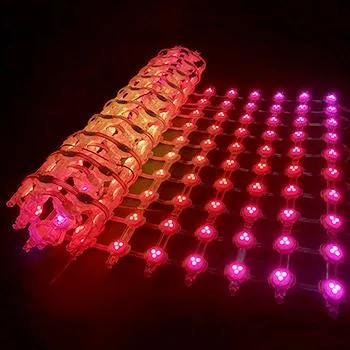
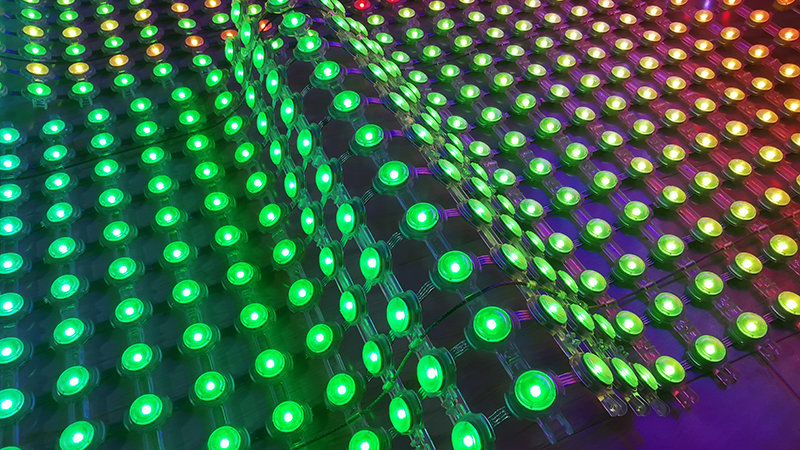
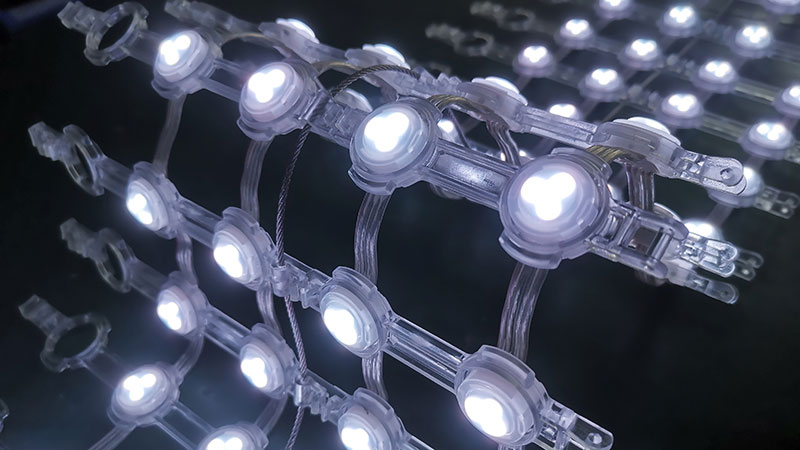
Close-up of illuminated P41.6 LED mesh pixels in clear PC housings, green and multi-colour light through the open mesh
Pixel level detail: one SMD3535 LED per pixel on the WGP-1 configuration, set in a clear PC housing.
Unlit transparent LED mesh strips showing the clear PC housing, pixel nodes and open grid structure of the P41.6 mesh
The same mesh unlit: the open grid is what gives the screen its 45% transparency and low wind load.

Model selection

Three models — choose by ambient light

All three configurations share the same 41.6 mm pitch, 576 dots/m², 16-bit grayscale, 140° viewing angle, 3,840 Hz refresh and IP67 rating. What changes is the number of LEDs per pixel, and with it brightness, contrast, power draw and weight. The deciding factor is how much light the installation has to compete with.

P41.6-WGP-1

2,500nits

LEDs per pixel
SMD3535 × 1
Contrast
1:1,200
Max / avg power
160 W / 70 W
Unit weight
4.5 kg
Supply voltage
DC 12 / 15 V

Suited toNight decoration, indoor and low-ambient surfaces, sculpture and landscape lighting where power and weight are tight.

P41.6-WGP-2

3,500nits

LEDs per pixel
SMD3535 × 2
Contrast
1:1,200
Max / avg power
340 W / 180 W
Unit weight
4.8 kg
Supply voltage
DC 12 V

Suited toMixed indoor and outdoor venues, covered walkways, stage backdrops and elevations in partial shade.

P41.6-WGP-3

4,800nits

LEDs per pixel
SMD3535 × 3
Contrast
1:2,000
Max / avg power
460 W / 240 W
Unit weight
5.1 kg
Supply voltage
DC 12 V

Suited toFacades facing daylight or strong street lighting, where the screen has to hold contrast against a bright background.

Moving up a model is not only a brightness gain: power draw roughly doubles from WGP-1 to WGP-3 and weight rises with it. Confirm the circuit capacity and the structural load before specifying the brighter option.

Specifications

P41.6 flexible LED mesh technical specification

Values below describe the three standard configurations. Power and weight are quoted per standard unit section; confirm the section size, driver IC and final datasheet for your order.

P41.6 flexible LED mesh screen — WGP-1 / WGP-2 / WGP-3

Parameter WGP-1 WGP-2 WGP-3
Optical
LEDs per pixel SMD3535 × 1 SMD3535 × 2 SMD3535 × 3
Pixel density 576 dots/m²
Pixel pitch 41.6 mm horizontal / 41.6 mm vertical
Grayscale 16 bit (65,536 levels)
Brightness 2,500 nits 3,500 nits 4,800 nits
Contrast ratio 1:1,200 1:1,200 1:2,000
Viewing angle 140° horizontal / 140° vertical
Transparency 45%
Electrical
Maximum power 160 W 340 W 460 W
Average power 70 W 180 W 240 W
Supply voltage DC 12 / 15 V DC 12 V DC 12 V
Refresh rate 3,840 Hz
Scan mode Static
Mechanical and protection
Unit weight 4.5 kg 4.8 kg 5.1 kg
Housing and base PC, clear or black
Ingress protection IP67
Lifespan ≥ 80,000 hours

Swipe horizontally to see all three models.

IP67 describes enclosure protection. It does not replace correct installation practice, cable-entry sealing, drainage or periodic inspection on a permanent outdoor installation.

Control

Novastar-compatible signal chain

The mesh runs on Novastar control products, with USB, HDMI and wireless distribution and management from a PC or smartphone. That makes it straightforward to add to an existing Novastar playback setup or to run content from a media player on site.

On a multi-zone facade or a set of separate structures, the control plan should define how content is split between sections, how zones are synchronised and how the signal reaches each one. Those decisions affect both the layout and the content workflow, and they are best settled before production rather than on site.

Novastar LED media player with Ethernet outputs used to drive a P41.6 flexible LED mesh screen
Novastar media player: content playback and Ethernet output to the mesh sections.
Tablet app used to manage and schedule content on a Novastar-controlled LED mesh screen
Wireless app management: content scheduling and playback control from a tablet.

The player, sending card and distribution hardware depend on total pixel count, zone layout and whether content is scheduled or played live. Send the pixel count with the enquiry so the signal chain can be specified with the screen.

Project case

Eight torch columns at Taihu Square

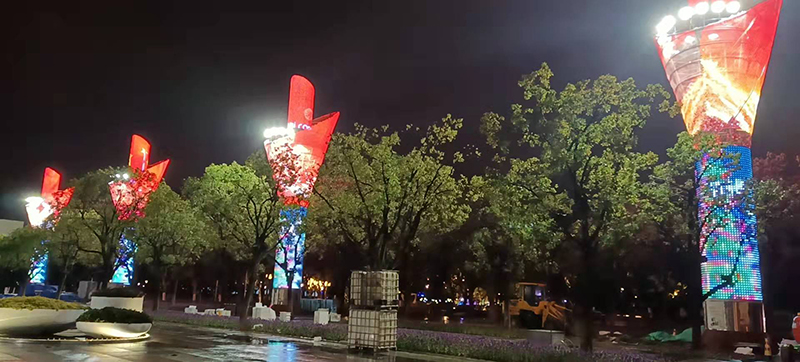
For the city’s New Year landscape lighting display, eight torch-shaped columns across Taihu Square were fitted with P41.6-WGP-1 mesh. The engineering problem was not brightness: it was making eight sculptural structures, each with a different curved surface, behave as one coordinated visual system.

Eight torch-shaped columns at Taihu Square lit with red and blue content on P41.6 flexible LED mesh during a New Year landscape lighting display
Eight columns, one show timeline: WTS Station playback over a fibre backbone, with a shared GPS time reference for cue alignment.
  • Structure: eight torch-shaped columns, each combining a narrow handle, a flared bowl and an open flame section.
  • Surface: the mesh is fixed over compound curves, where a rigid cabinet cannot follow. Surfaces were modelled in 3D and decomposed into installable sections.
  • Pixel map: every LED node was given a coordinate, so content lands upright on leaning and angled surfaces instead of being stretched from a flat file.
  • Control: WTS Station for multi-screen synchronous playback, a gigabit optical fibre link to the master control platform, and a GPS timing reference for cue alignment.
  • Operation: a permanent installation that runs seasonal shows by changing content, without changing hardware.

Read the full Taihu Square case study

Photographs from the Royal AD Tek project record. Site access, sealing, drainage and inspection intervals are part of the permanent-installation scope, not of the screen specification alone.

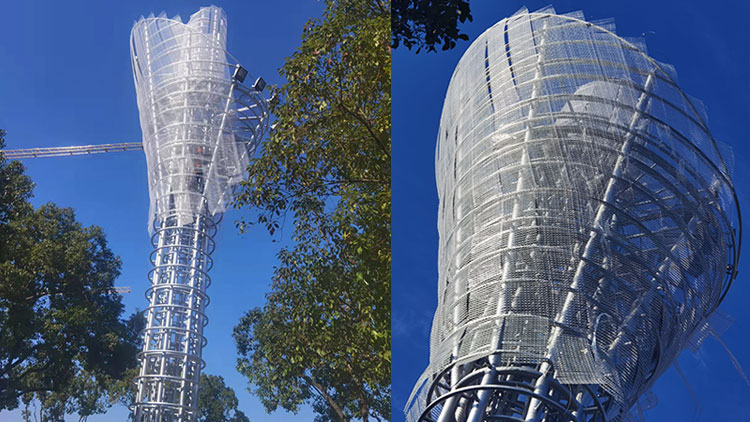
Daytime view of a torch column sculpture with flexible LED mesh being fixed over the curved bowl and handle sections
Daylight view during installation: the mesh follows the bowl and handle, and the 45% open area keeps the sculpture readable when unlit.

Applications

Where a 41.6 mm mesh makes sense

The pitch suits mid- and long-distance viewing, so it is specified where the audience is metres away rather than close enough to read small text.

  • Building facadesMedia surfaces that keep windows and structure visible
  • Stage backdropsRollable transport, fast rigging, curved layouts
  • Shop frontsHigh-transparency window displays and brand activations
  • Sculpture and landscapeTowers, bridges and feature structures
  • Hospitality interiorsCeilings, bars and decorative pixel-mapped effects
  • Event and festival buildsShort-duration installations with tight strike times

Related formats: P50 pixel mesh curtain for larger-format viewing, P1531 outdoor LED mesh panel for a finer pitch, and the full LED mesh screen range.

Installation and support

What the project needs beyond the screen

Tool-free connections shorten assembly and rollable sections cut transport volume, but the mesh is only one part of a permanent installation. Plan the mounting structure, power distribution and service access together with the screen layout: the low weight per section helps, while the supporting structure and wind area still need engineering.

Structure and wind

Transparency reduces wind area but does not remove it. Fixing centres, substrate and load path are set by the structure, not by the screen weight alone.

Power and voltage drop

Long runs on tall structures need circuit planning. WGP-3 draws close to three times the current of WGP-1, so the supply design follows the model choice.

Service access and spares

A failed strip inside a sealed section is not a quick fix. Design a maintenance route to every section and hold spare sections from the same production batch.

P41.6 flexible LED curtain technical specificationsPDF datasheet — pitch, brightness options, power, weight, IP rating and housing.

Download the datasheet (PDF)

FAQ

P41.6 flexible LED mesh questions

What is the difference between P41.6-WGP-1, WGP-2 and WGP-3?

LEDs per pixel, and with it brightness, contrast, power and weight. WGP-1 uses one LED per pixel at 2,500 nits and 160 W maximum; WGP-2 uses two at 3,500 nits and 340 W; WGP-3 uses three at 4,800 nits, 1:2,000 contrast and 460 W. Pitch, pixel density, grayscale, viewing angle, refresh and IP rating are identical across the three.

How much resolution does a 41.6 mm pitch give?

576 pixels per square metre. A 10 m² section carries roughly 5,760 pixels, so content should be designed for viewing at distance rather than for close reading. For text-heavy or close-viewed content, a finer pitch such as the P1531 mesh is the better fit.

Can the mesh be curved or cut to an irregular shape?

The flexible mesh follows curves, arches and custom forms, which is why it is used on sculpture and facade features. Final shape, section size and pixel mapping are project-specific and must be confirmed before production — on an irregular surface the pixel map is a deliverable, not an afterthought.

Is IP67 enough for a permanent outdoor installation?

IP67 protects the enclosure against dust and water ingress. Long-term reliability also depends on installation quality, cable-entry sealing, drainage and scheduled inspection — none of which the rating covers on its own.

Which controller do I need?

The screen is compatible with Novastar control products and supports USB, HDMI and wireless management. The exact player and sending configuration depends on total pixel count, zone layout and whether content is scheduled or played live; send the pixel count and we will specify the chain with the screen.

Will it be visible in daylight?

Visibility depends on ambient light and the model chosen. WGP-3 at 4,800 nits is intended for brighter environments, but a specification number is not the same as on-site readability against direct sun on a facade. Confirm expected performance with a site assessment rather than from the datasheet alone.

How much power and weight should I plan for?

For WGP-1, 160 W maximum and 70 W average per square metre, at 4.5 kg per standard unit section. WGP-2 and WGP-3 rise to 340 W and 460 W maximum, with unit weights of 4.8 kg and 5.1 kg. Confirm the section size and supply configuration for the actual layout.

What do you need to quote a mesh screen?

The surface dimensions or drawings, the viewing distance, the ambient light at the installation, and the mounting structure or substrate. For a curved or sculptural project, a 3D model or measured sections shorten the design stage considerably.

Specify a P41.6 mesh screen

Send the facade dimensions, viewing distance, ambient light conditions and mounting details. We will recommend the model, section layout and control plan, and confirm lead time.

Request a Specification & Quote

Related Products

P1531 Outdoor LED Mesh Panel

P1531 Outdoor LED Mesh Panel

P50-3 LED Mesh Display

P50-3 LED Mesh Display

Holographic Transparent LED Display

Holographic Transparent LED Display

LED Magic Mesh

LED Magic Mesh

Product Categories

  • Drone Flying LED Screen
  • LED Mesh Screen
  • Transparent LED Screen
  • Digital Water Curtain

Links

Google.comFushilongNovastarBaidu.com

Feedback

Contact Us

8615150798219

15150798219

info@royaladtek.com

peterwu1987

Beidou Electronic Information Industrial Park, Suqian High-tech Industrial Development Zone, Suqian City, Jiangsu Province, China

MOBILE WEBSITE

© 2026 All Rights Reserved.

  • 15150798219
  • info@royaladtek.com
  • 8615150798219 Scan to chat on WhatsApp
  • WeChat QR Code Scan to chat on WeChat
  • Get a Quote
  • Back to Top

Online Inquiry

Get a quote within 12 hours

Tell us what you need — we'll reply as soon as possible.

WhatsApp
Phone
E-mail
Inquiry