
How Eight Torch Columns Light Up as One Installation: Taihu Square Case Study
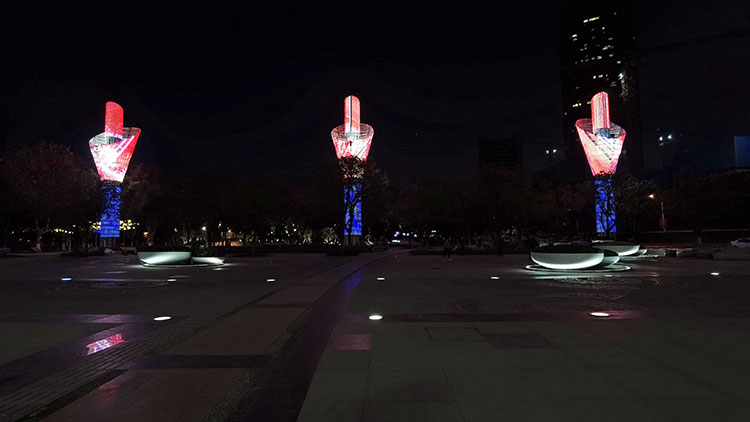
Eight torch-shaped columns at Taihu Square were fitted with Fushilong P41.6-WGP-1 flexible LED pixel mesh for the city's New Year landscape lighting display. The engineering challenge was not brightness. It was making eight separate sculptural structures, each with a different curved surface, behave like one coordinated visual system — designed through 3D modelling and controlled through WTS Station with a gigabit fibre backbone and a shared GPS timing reference.
The Short Version
- Problem: eight irregular, torch-shaped structures had to show coordinated content, not eight unrelated light patterns.
- Approach: model the geometry in 3D, decompose each surface into pixel-mappable sections, then design structure, power and control around that map.
- Control: one master platform, a fibre backbone, WTS Station for multi-screen synchronous playback, and a GPS time reference for cue alignment.
- Result: a permanent sculpture installation that can run seasonal shows by changing content, without changing hardware.
1. Why a Torch Shape Is Harder Than a Rectangle
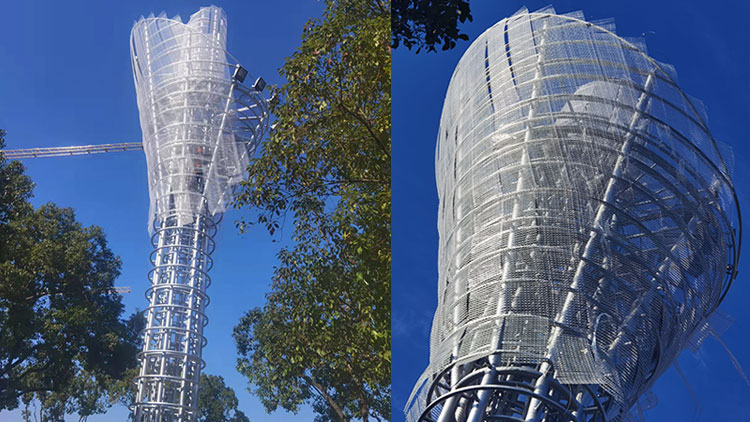
A rectangular LED wall has a predictable pixel grid. A torch sculpture does not. The form combines a narrow handle, a flared bowl and an open flame section, and each of the eight columns presents those surfaces at different angles to the viewer.
Three practical consequences follow:
- Pixel density is not uniform in the viewer's eye. A surface angled away from the audience compresses visually, so content must be designed for the actual sightlines rather than the flat artwork.
- The mesh must follow compound curves. Flexible pixel mesh is chosen for this reason: it can be shaped over curved and irregular surfaces that rigid cabinets cannot follow.
- Service access has to be designed in. A permanent outdoor sculpture needs a maintenance route to every section, because a failed strip inside a sealed flame section is not a five-minute fix.
2. From 3D Model to Pixel Map
Our technical team worked from 3D modelling and decomposition rather than from 2D drawings alone. The workflow for this type of project typically runs as follows:
- Model the structure — capture the actual geometry of each column section, including curvature and connection points.
- Decompose the surface into installable panels and pixel zones that match the mesh's physical format.
- Build the pixel map — assign every LED node a coordinate so playback software knows where each part of the video lands. This map is what allows an abstract flame texture to appear upright on a leaning surface.
- Design structure and power — define mounting, suspension, cable routing and power distribution per section, with voltage-drop and load calculations.
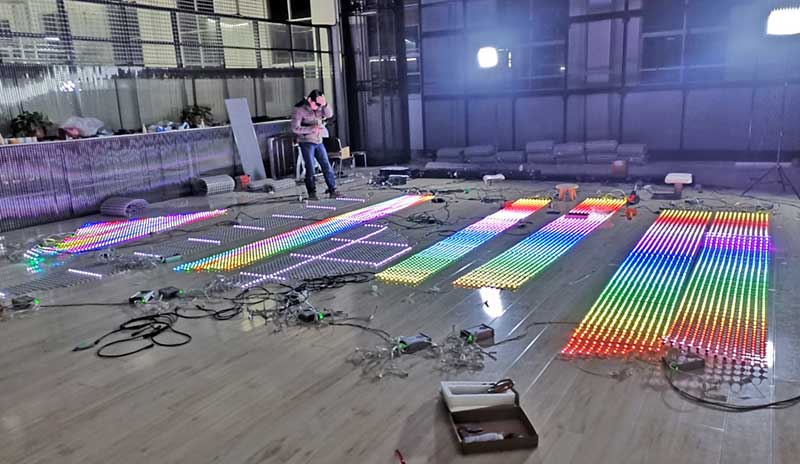
- Commission with test patterns — run alignment, colour and timing tests before creative content is approved.
3. Control Architecture: Three Layers, Three Jobs
The installation used WTS Station for multi-screen wireless synchronous playback of the irregular-shaped displays, with gigabit optical fibre connecting to the master control platform, and GPS providing a shared timing reference.
These layers are often confused in project descriptions, so it is worth separating them:
- Fibre transport carries content and control data reliably over distance — the reason a plaza-wide installation does not depend on Wi-Fi coverage.
- WTS Station manages multi-screen synchronous playback, so eight display nodes follow one show timeline rather than eight independent players.
- GPS timing supplies a common time reference, which keeps cue starts aligned even when nodes are distributed across the site.
Synchronization is a timing result, not a visual one. Matching playback start times does not by itself correct perspective, brightness differences between columns or camera flicker; those are separate calibration and content tasks.
4. Product Choice: What P41.6-WGP-1 Provides
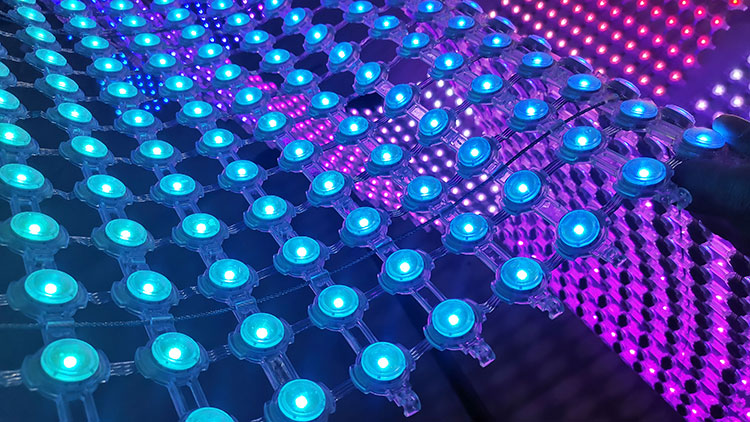
The display used the P41.6-WGP-1 configuration of our flexible pixel mesh. Its characteristics suit permanent outdoor sculpture work:
| Parameter | Value | Why it matters here |
|---|---|---|
| Pixel pitch | 41.6 mm | Suited to mid- and long-distance viewing across a plaza |
| Pixel density | 576 dots/m² | Defines content resolution per square metre of surface |
| Brightness | 2,500 nits (WGP-1 variant) | Balanced for night illumination without over-driving |
| Grayscale | 16 bit (65,536 levels) | Smoother gradients in flame and sky effects |
| Refresh rate | 3,840 Hz | Reduces banding when filmed by event cameras |
| Transparency | 45% | Keeps the sculpture readable in daylight and lowers wind load |
| Ingress protection | IP67 | Outdoor installation exposed to rain and washdown |
| Power / weight | 160 W max, 70 W average per m²; 4.5 kg per unit | Drives circuit planning and structural load checks |
IP67 describes enclosure protection. It does not replace correct installation practice, drainage, sealing checks or periodic inspection.
5. Daylight, Weather and Long-Term Operation
Holiday installations are judged twice: at night, and in the daytime when the structure is unlit. A 45% transparent mesh reads as a light grid rather than a solid panel in daylight, which is often preferable on a sculptural landmark.
For a permanent outdoor piece, plan for:
- Sealing and drainage at every joint, plus inspection intervals after storm seasons.
- Power redundancy and accessible isolation for maintenance.
- Content rotation by season and festival, using the same pixel map.
- Spare sections matched to the original batch, since colour and brightness consistency between production runs must be managed.
6. Project Images
Video: a project clip of the square tower illumination is available on request. Replace this block with your hosted video embed (MP4 or platform player) once uploaded, and keep the poster image above as the fallback frame.
7. Specification Checklist for Sculpture and Tower Projects
| Item to confirm | Why it decides the project |
|---|---|
| Site survey and 3D geometry | Determines panel layout, pixel map and mounting detail |
| Viewing distances and sightlines | Sets pixel pitch and content resolution |
| Structural load and wind area | Transparency and weight per m² affect the support design |
| Power distribution and voltage drop | Long runs on tall structures need circuit planning, not just cable |
| Control topology | Fibre, wireless links and timing references must be specified together |
| Commissioning test plan | Defines measurable sync, colour and brightness acceptance criteria |
| Service access and spares | Determines lifetime cost of a permanent installation |
8. Frequently Asked Questions
How do you display video on an irregular sculpture?
By modelling the surface in 3D, decomposing it into mappable sections and building a pixel map that assigns each LED node a position in the playback canvas. Content is then designed for that map and the actual viewing angles.
Can all eight columns show the same video at the same time?
Yes. WTS Station manages multi-screen synchronous playback, with a GPS timing reference and a fibre link to the master platform. Each column still needs its own pixel map because its surface geometry differs.
Does GPS synchronization remove the need for a fibre link?
No. They solve different problems: fibre carries content and control data over distance, while GPS provides a shared time reference for cue alignment.
Is IP67 enough for a permanent outdoor installation?
IP67 protects the enclosure against dust and water ingress, but long-term reliability also depends on installation quality, drainage, sealing maintenance and periodic inspection.
Can the content be changed after installation?
Yes. Because the pixel map and control system stay in place, new seasonal or festival content can be produced and scheduled without replacing hardware.
Planning a Landmark Lighting Project?
Share the structure's drawings or 3D model, the viewing distances, the required show duration and the site's power and access conditions. We will specify the mesh format, pixel map approach, control topology and structural requirements together.
Related reading: multi-screen synchronization on flying LED displays · 1,300 m² bridge LED node strand display · drone light show LED mesh fabric.