

Multi-Screen Sync: How 3 Flying LED Mesh Screens Play One Video in Perfect Frame-Level Sync
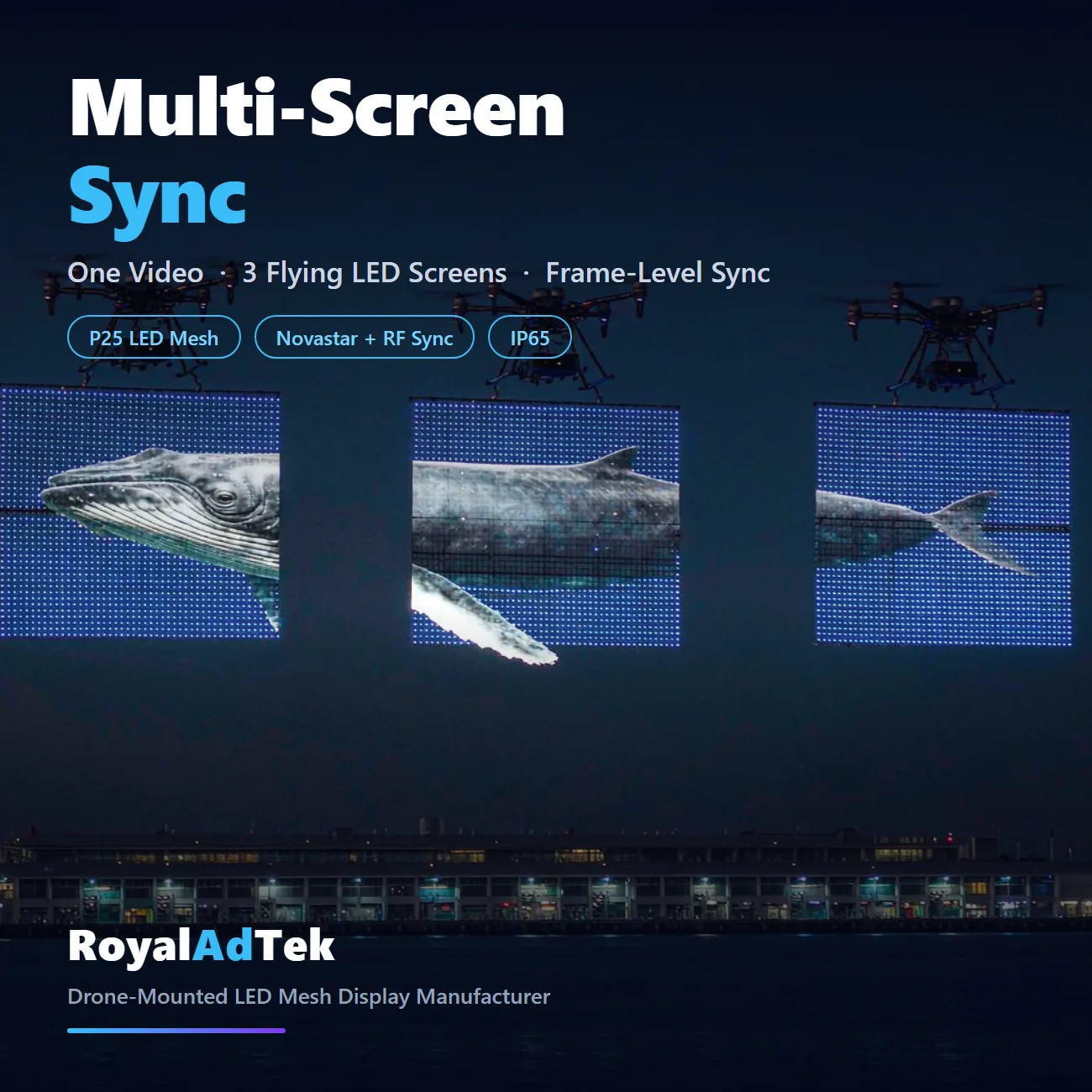
At the 2026 New Year countdown in Lianyungang, our three P25 drone light show LED mesh fabric screens rose into the night sky and did something a single drone screen cannot: they played one continuous video across three separate screens, each hanging from its own heavy-lift drone, with every frame landing at exactly the same moment. This article explains how multi-screen synchronization works — and why frame-level sync is the line between a true "flying video wall" and a drone that simply carries a picture.
Two Ways to Sync Multiple Flying LED Screens
Multi-screen flying LED shows support two playback modes. Both were proven in our 3-set P25 deployment, and they solve two different creative problems.
Mode 1: Synchronized Playback (Same Video on All Screens)
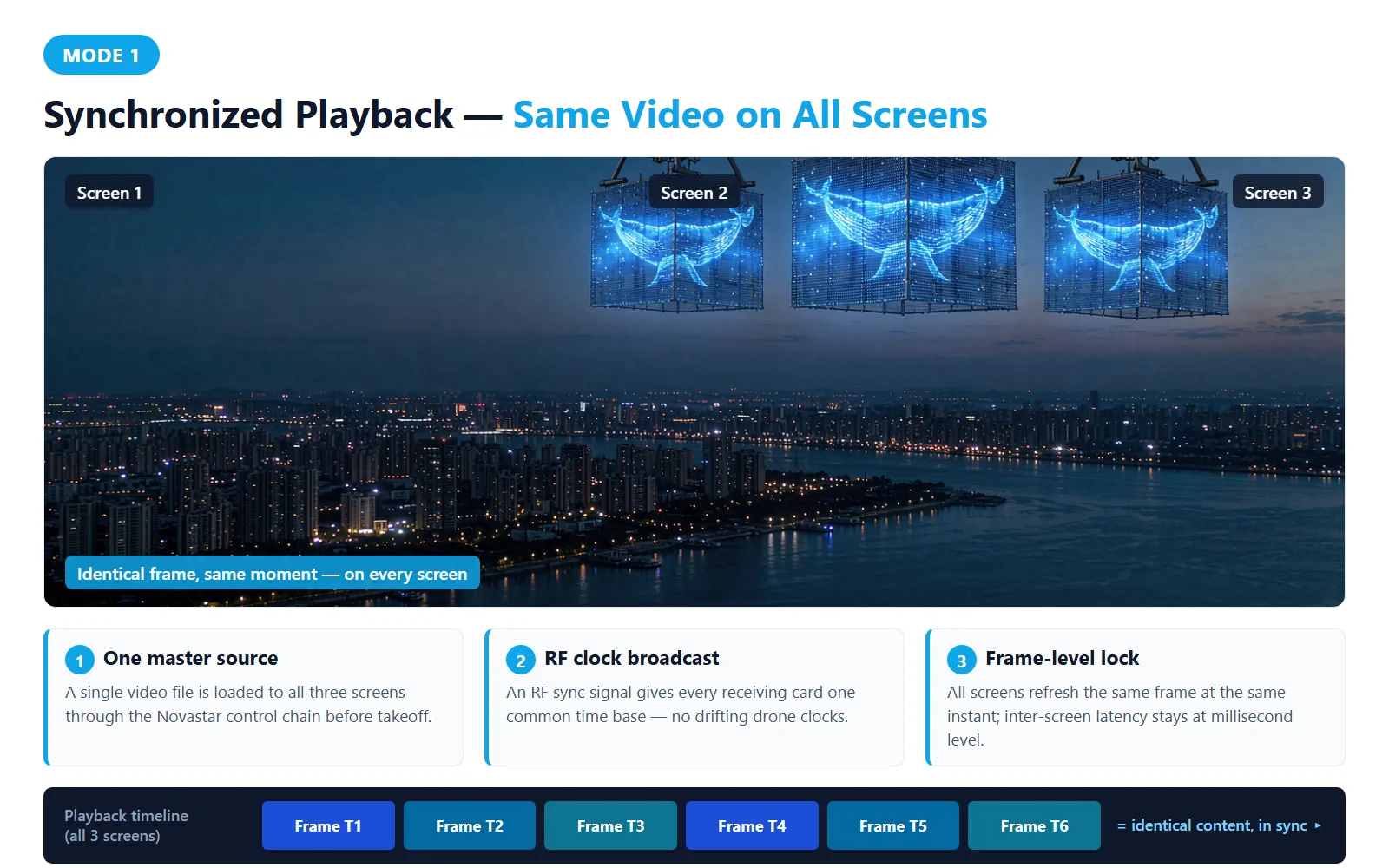
- What the audience sees: the same video — logo, countdown, slogan — repeated on every screen across the airspace, so every viewing angle gets the full message.
- How it works: one master video is loaded to all screens through the Novastar control chain before takeoff; an RF sync signal gives every receiving card a common time base; all screens refresh the same frame at the same instant, keeping inter-screen latency at millisecond level.
- Best for: city countdowns, stadium moments, brand slogans — anywhere the message must read identically from any position on the ground.
Mode 2: Split-Screen Playback (One Video Across All Screens)
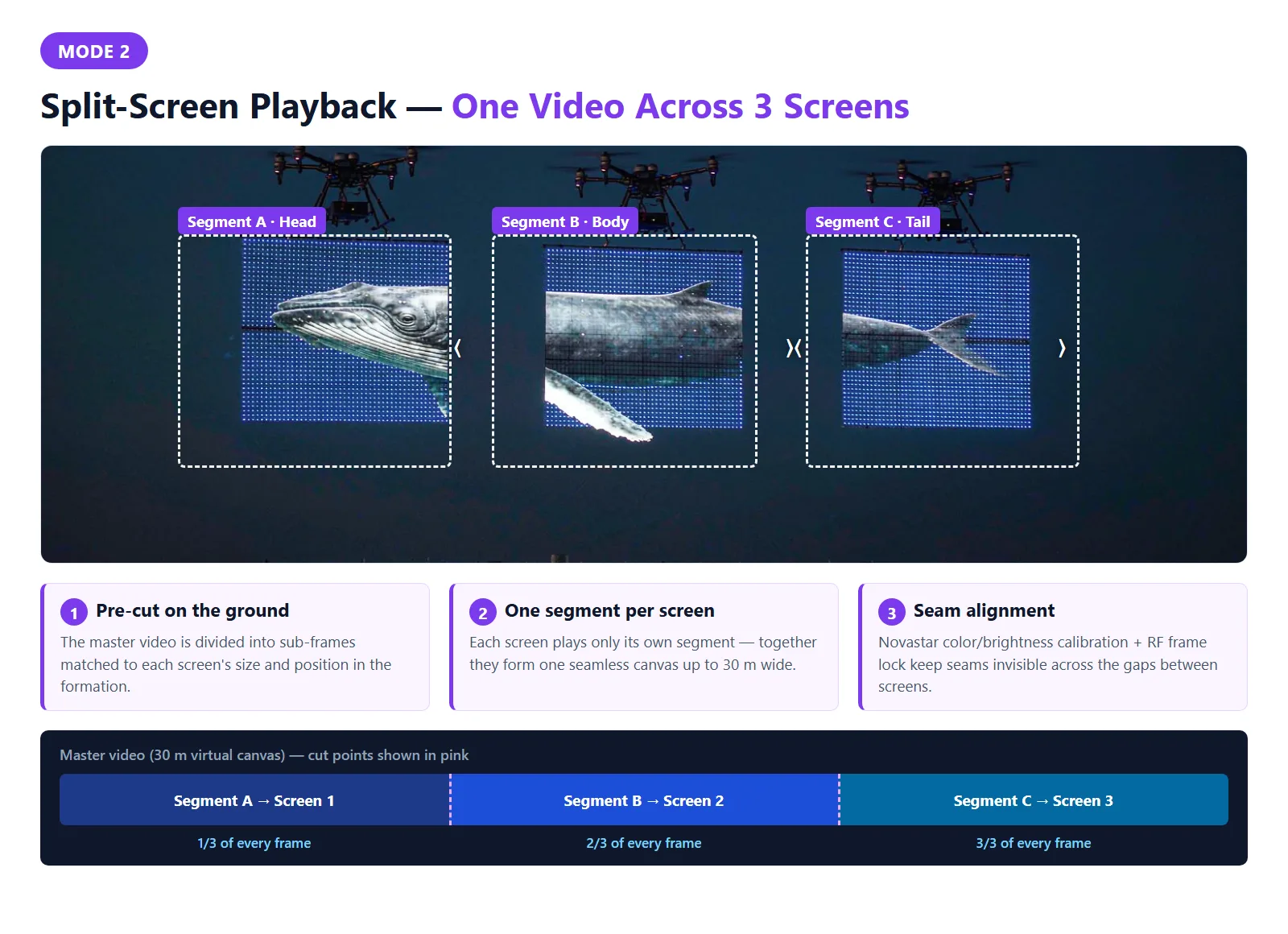
- What the audience sees: one giant image floating in the sky — in our whale demo, the head swims on Screen 1, the body crosses Screen 2, the tail lands on Screen 3.
- How it works: the master video is pre-cut on the ground into sub-frames matched to each screen's size and position in the formation; each screen plays only its segment; Novastar color/brightness calibration plus RF frame lock keep the seams invisible across the gaps.
- Best for: cinematic reveals, product films, narrative sequences — content that needs a canvas no ground LED rental could deploy this fast.
The split-screen mode is the harder engineering problem, and it is where frame-level sync earns its name: if one screen drifts even a few frames ahead, the whale's tail swims before its head.
How the Synchronization Works: Novastar Control + RF Sync
Our multi-drone LED system is built on a Novastar control system paired with RF (radio-frequency) synchronization — the same display-control architecture trusted in fixed LED installations, adapted for flight:
- Novastar receiving cards in every screen handle uniform brightness, color calibration and grayscale across all units, so the screens read as one continuous image with no visible seams in color or luminance.
- RF sync broadcasts a common timing reference to all screens simultaneously. Instead of relying on each drone's independent clock (which drifts), every receiving card locks its frame refresh to the same RF time base, keeping inter-screen latency at millisecond level.
- Content pre-splitting on the ground means no real-time re-compositing in flight — the formation flies, the canvas simply follows.
- GNSS/GPS-assisted triggers add a secondary sync layer for shows spanning larger distances or multiple formations.
Why Frame-Level Sync Is Hard in the Air
- No cables: every screen runs on its own battery and wireless link, so timing must be distributed over the air (RF) rather than through a wired loop.
- Moving platforms: drones adjust position constantly, so brightness and orientation must be corrected live.
- Wind and vibration: in 6-level wind the flexible LED mesh flexes; high brightness and a 3840Hz+ refresh rate keep the image stable and camera-friendly.
Where Multi-Screen Flying LED Displays Are Used
- City events & countdowns: wide-format aerial video walls over waterfronts and squares (see our Lianyungang 2026 countdown show)
- Sports & stadium entertainment: coordinated slogans and replay-style visuals above the crowd
- Brand launches: one product film split across a 30 m aerial canvas — popular for flagship openings in the Middle East and Europe
- Tourism & cultural shows: narrative sequences where each screen carries a chapter of the story
Specifications: 3-Set P25 Flying LED Mesh Screen System
| Item | Spec |
|---|---|
| Pixel pitch | P25 (1,600 px/㎡) |
| Screen type | Flexible LED mesh fabric for drone light shows, 70% transparent |
| Brightness / refresh | High-brightness night aerial use, 3840Hz refresh |
| Control system | Novastar control system + RF synchronization |
| Sync modes | Full synchronized playback / split-screen one-video playback |
| Protection | IP65 waterproof, wind-resistant flexible structure |
| Carrier | Heavy-lift drone (one per screen), flexible deployment |
FAQ
How many flying LED screens can be synchronized?
The same RF sync architecture scales beyond three units; formation size is mainly limited by airspace approval and drone logistics.
Does split-screen mode need a different video file?
Yes — the master video is pre-cut into per-screen segments matched to each screen's position in the formation, then loaded before flight.
Can the show switch between synchronized and split-screen playback mid-flight?
Yes. Both modes run on the same Novastar + RF sync chain and can be toggled by the ground operator between scenes.
How large can a multi-screen flying LED canvas get?
With 3 screens of 5×10 m each, the effective canvas reaches about 30 m in width; larger formations scale the canvas proportionally.
Planning a multi-screen flying LED show for your event, brand launch or city celebration? Explore our drone light show LED mesh fabric or contact RoyalAdTek — as a direct drone LED display manufacturer we ship complete screen, control and show-support packages worldwide.


