
We Made It, We Fly It: A 324 m² Drone-Mounted LED Mesh Screen
Two heavy-lift drones, one continuous airborne display, flown in November 2025
RoyalAdTek / FUSHILONG designed, built and flew a 324 m² drone-mounted LED mesh screen — a 27 m × 12 m transparent display lifted by two DJI Agras T100 heavy-lift drones. This page documents the format, the payload maths behind it, and the constraints that decide whether a screen this size can be flown safely and read from the ground.
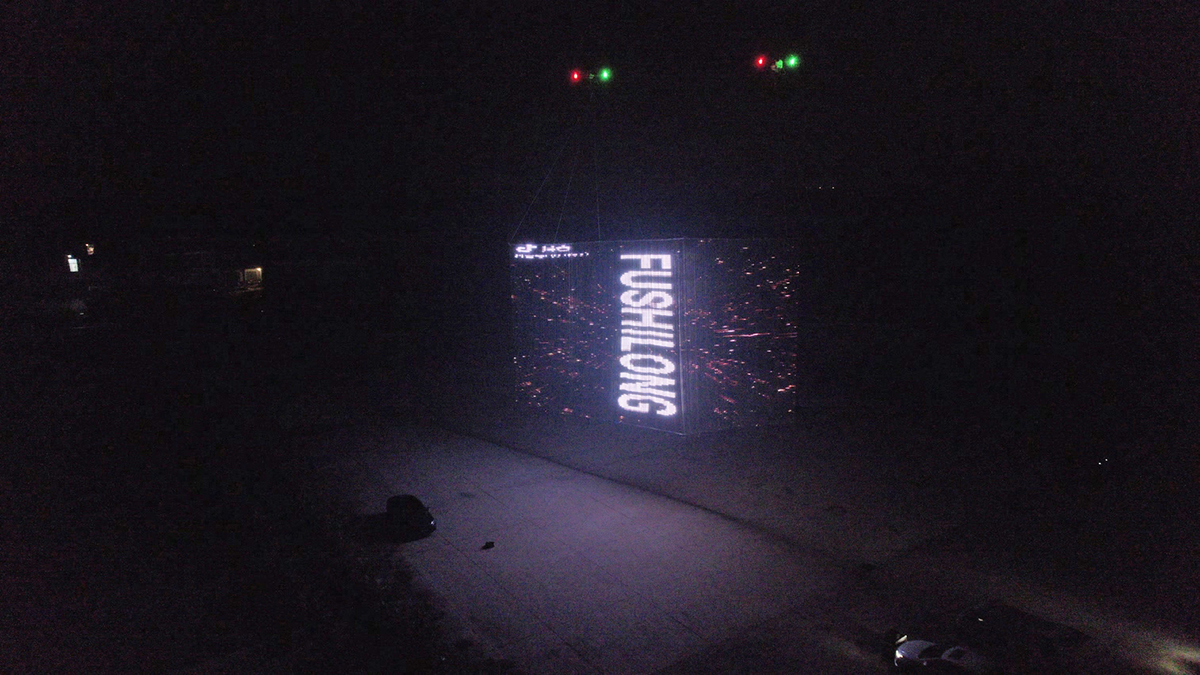
Watch the Flight
1. Why 324 m² Changes the Engineering
Small flying screens are a payload problem. A 324 m² screen is a systems problem, because four constraints collide at once:
- Mass. A standard P25 mesh at about 0.7 kg/m² would put 324 m² near 210 kg before batteries and rigging. The custom P100 format at 0.35 kg/m² brings the mesh itself down to roughly 113.5 kg — the difference that makes a two-drone lift comfortable instead of marginal.
- Wind area. A 27 m wide panel acts as a sail. High transparency reduces the load, but it does not make the surface immune to gusts — the operating limit comes from the aircraft and rigging design, not from a marketing figure.
- Structural continuity. A single 27 m span must behave as one surface. Panel joints, tensioning and suspension points determine whether the image reads as a wall or as a patchwork.
- Flight time. Adding area adds weight and power draw, which trades directly against duration. Every kilogram saved in the mesh buys minutes in the air.
2. The Screen Itself
The display is a flexible LED mesh: an open pixel grid that lets air through, rolls for transport and weighs a fraction of a rigid cabinet wall. The reference format for this project was 27 m × 12 m; smaller formats such as 5 × 10 m use the same construction, which is what makes the range scalable from a single-screen activation to a record-scale canvas.
| Parameter | Value | Why it matters at 324 m² |
|---|---|---|
| Pixel pitch | 100 mm (P100, custom) | Sets both resolution and weight — the trade-off this project is built on |
| Pixel density | 100 dots per m² | A low-density light canvas, not a video wall |
| Mesh weight | 0.35 kg per m² | ≈113.4 kg for 324 m² — the key to a dual-drone lift |
| Format | 27 m × 12 m reference | Single continuous surface, rollable for transport |
| Brightness | Project-specified | Configured for the show window; confirm the final figure |
| Grayscale / refresh | Project-specified | Refresh must be verified against the event cameras |
| Protection | IP-rated enclosure | Dust and water protection — not a flight-weather rating |
P100 is a custom format built for this project, not a catalogue item. Weight covers the mesh only — batteries, cables, suspension hardware and the drone interface are additional. Brightness, grayscale and refresh are confirmed per order.
3. The Pixel Reality of a Huge Screen
A large screen is not automatically a high-resolution screen. At a 100 mm pitch, 27 × 12 m resolves to about 270 × 120 pixels — roughly 32,400 pixels spread across 324 m². That is by design: the P100 format trades pixel count for the 0.35 kg/m² weight that makes the flight possible.
For multi-screen work — for example two or three 5 × 10 m screens carrying one composition — playback is coordinated through NovaStar control with RF synchronization. See the multi-screen synchronization guide for how same-content and split-video modes differ.
4. Flying a 27 m Span with Two Drones
Dual-drone lift is not two drones tied to one screen. It is a control problem:
- Load sharing — the two aircraft must carry a predictable share of the load throughout the flight envelope; the rigging geometry defines how that share is distributed.
- Synchronized flight control — position and attitude corrections must be coordinated, or the screen twists and the image skews.
- Redundancy — loss of one aircraft or one link is a defined procedure, not an improvisation. This is the part clients should ask about first.
- Ground crew — pilot(s), screen technician and a safety lead, with a site-specific emergency plan and a cleared operating area.
Aviation approval, spectator separation, insurance and operating limits are location-specific and arranged with the local operator. We supply the screen system; drone operation and permits are agreed per project.
5. Where a Screen This Size Makes Sense
- City-scale events and countdowns — one surface readable across a plaza or waterfront
- Brand launches — a single hero visual instead of a fragmented multi-billboard buy
- Stadium and festival moments — overhead content synced to a ground show
- Tourism campaigns — a moving landmark that photographs well from a distance
For permanent architectural work with the same mesh logic, see the 13 m torch-column sculpture case study. For format comparison against drone swarms and fireworks, read the 2026 aerial show comparison.
6. Frequently Asked Questions
Is this a Guinness World Record?
We describe it as our largest single airborne screen to date, flown in November 2025. We do not claim third-party certification unless a certificate is issued for the specific attempt; if a verified record matters to your campaign, ask for the certification documents in writing.
How big is 324 m² in practical terms?
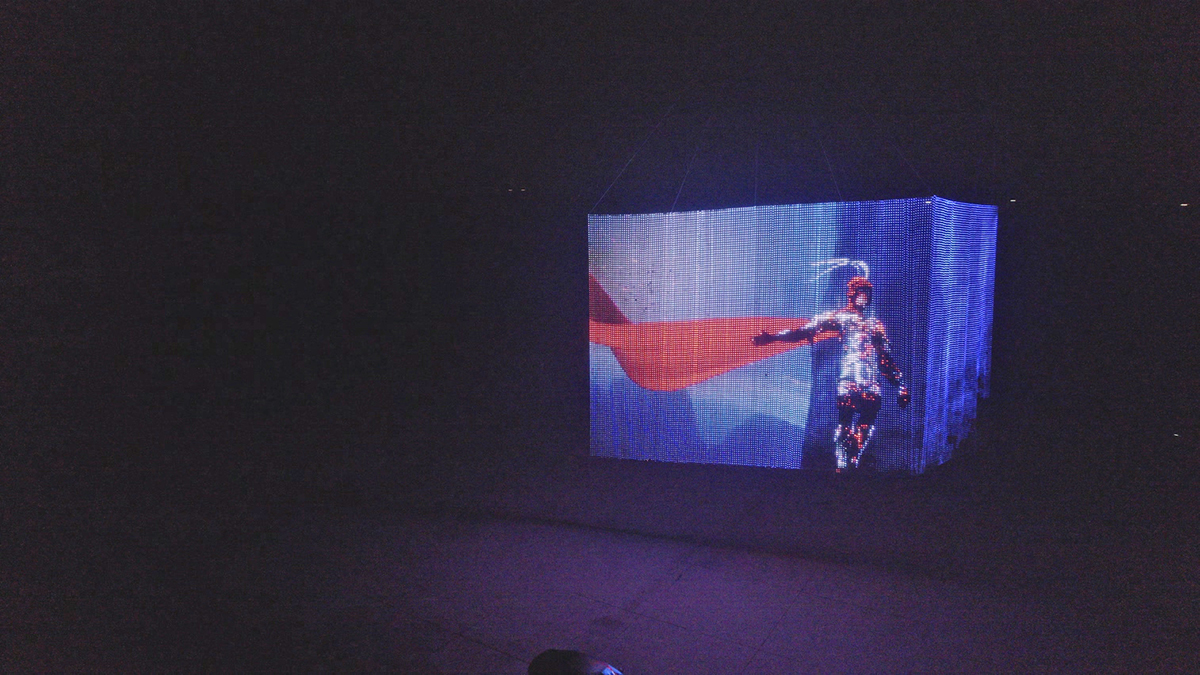
27 m wide by 12 m high — roughly the facade of a six-storey building. It is flown as one continuous surface, not as separate panels in the sky.
What resolution does it have?
Resolution follows pixel pitch, not area. This screen uses a custom 100 mm pitch, so 27 × 12 m is about 270 × 120 pixels (≈32,400 pixels). It is built for large graphics and short words at long viewing distance, not for detailed video.
How long can it stay airborne?
Duration depends on the battery configuration, brightness and payload margin. Published figures for smaller formats are around 45–60 minutes; a 324 m² build must be confirmed in the project plan.
Can it fly in wind or rain?
Operating limits come from the aircraft, the rigging and the operator's risk assessment. IP65 protects the enclosure; it is not permission to fly in adverse weather.
Do you supply the drones and pilots?
We supply the screen system, power, rigging hardware and control. Drone supply and local operation are arranged per project, because permissions and insurance are location-specific.
Related: flying LED mesh fabric specifications · P25 flying LED screen. Dimensions, payload and flight duration are confirmed per project; specifications on this page are reference values.