Flying LED Screen vs Drone Light Show vs Fireworks: Which Is Right for Your Event?
Aerial entertainment can carry a brand message, tell a story or deliver a dramatic finale. A flying LED screen, a drone light show and fireworks achieve these goals in different ways. This guide compares their content capabilities, production requirements, costs and operating constraints so you can choose the right format for your venue and audience.
1. What Is the Difference Between the Three Formats?
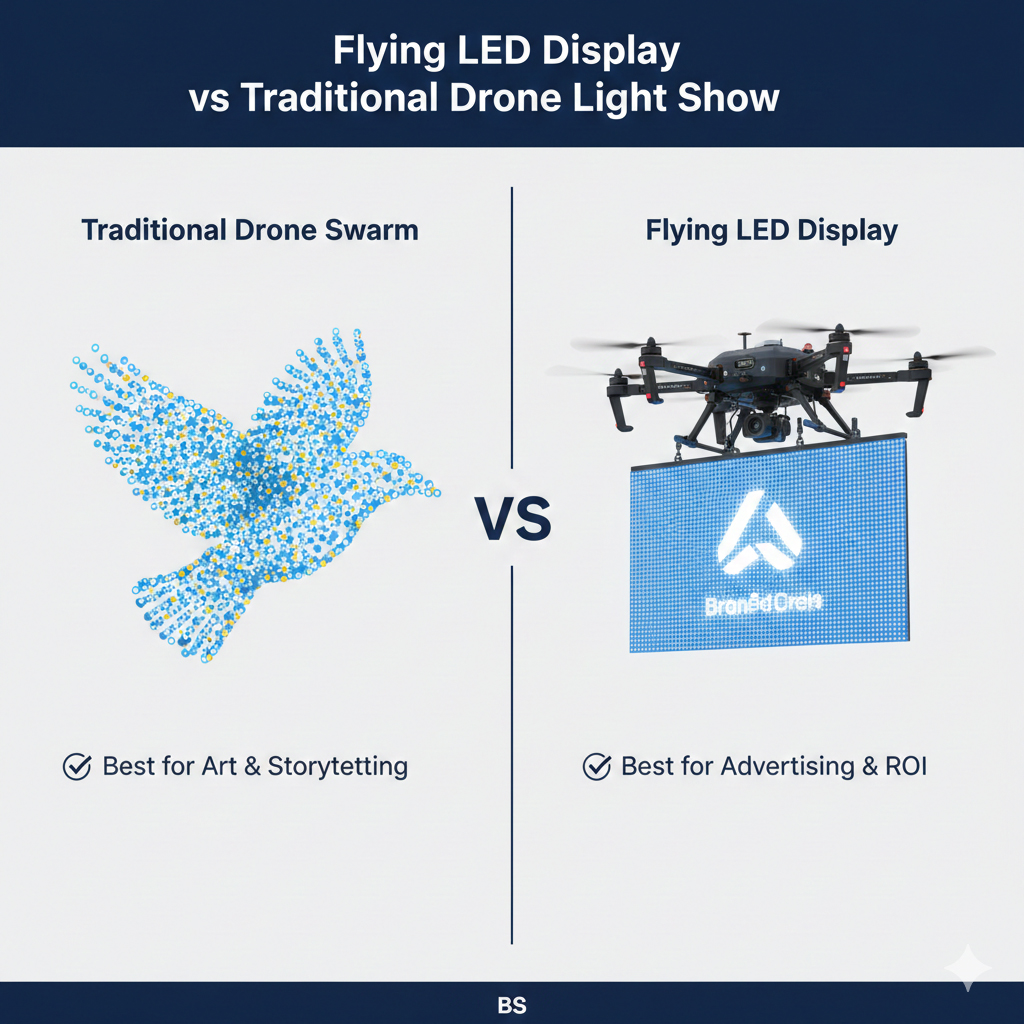
Flying LED Screen: A Drone-Carried Video Display
A flying LED screen is a lightweight LED mesh display suspended beneath a suitable heavy-lift drone or an engineered multi-drone lifting system. Unlike a swarm in which each aircraft is a light point, the screen contains its own LED pixel grid. It plays content within a defined rectangular display area.
RoyalAdTek's drone light show LED mesh fabric is designed for aerial displays and event advertising. Screen size, pixel pitch, batteries, rigging and aircraft compatibility must be specified together.
Drone Light Show: Choreographed Points of Light
A drone light show uses multiple illuminated aircraft following coordinated flight paths. Together they create text, logos, outlines and animated formations. The number of drones, spacing, flight envelope and audience distance determine how much detail the display can convey. Large formations can produce compelling brand imagery; they are not equivalent to a conventional video screen.
Fireworks: Pyrotechnic Light, Color and Sound
A fireworks display uses pyrotechnic effects to create bursts, patterns and sound, often choreographed to music. It is especially suited to ceremonial moments and finales. Specialized effects can create limited symbols or patterns, but fireworks are not a practical medium for conventional video playback or frequently changing advertising messages.
2. Flying LED Screen vs Drone Light Show vs Fireworks: Comparison Table
The table below compares typical production characteristics. It is a planning guide, not a guarantee of price, setup time, operating permission or weather capability.
| Factor | Flying LED Screen | Drone Light Show | Fireworks |
|---|---|---|---|
| Primary strength | Video content and direct brand communication | Spatial formations and large-scale storytelling | Explosive spectacle and ceremonial impact |
| Visual content | Video, animations, logos and text within the screen's native resolution | Text, logos, shapes and animations formed by illuminated aircraft | Bursts, colors and choreographed effects; limited specialized patterns |
| Fine detail | Depends on pixel pitch, screen size, contrast and viewing distance | Depends on aircraft count, spacing, formation scale and viewing distance | Not intended for detailed commercial video |
| Content revisions | Media changes may not require flight-path changes; test playback and timing | Formation changes may require flight-path checks and safety validation | Changes depend on effect selection, firing design and permissions |
| Live inputs | Possible only with an appropriate video-input and transmission configuration | Usually preplanned choreography; live interaction is system-dependent | Timed cues rather than conventional live video |
| Site requirements | Payload-compatible aircraft, rigging clearance and a controlled operating area | Suitable launch layout, flight volume and audience separation | Authorized firing location, fallout area and fire-safety controls |
| Sound and residue | Rotor noise; no pyrotechnic smoke during the display | Rotor noise; no pyrotechnic smoke during the display | Impulse noise, combustion emissions and possible debris |
| Weather constraints | Wind, gusts, precipitation, screen drag and loaded-aircraft limits | Wind, precipitation, visibility and formation-control limits | Wind, fire risk, visibility and product-specific operating conditions |
| Reusability | Screen and aircraft can be reused, with inspection and maintenance | Aircraft can be reused, with inspection and maintenance | Pyrotechnic effects are consumed; some firing equipment is reusable |
| Main budget drivers | Screen system, lifting capacity, crew, logistics, content and permissions | Aircraft count, animation complexity, crew, logistics and permissions | Effect selection, duration, crew, transport, site controls and permissions |
| Typical fit | Product launches, sponsor messages and aerial video campaigns | City celebrations, cultural stories and formation-based branding | Festivals, traditional celebrations and finales where permitted |
3. Visual Impact: Brand Communication vs Spatial Storytelling
Use a flying LED screen when the audience needs to see your actual media assets. Product footage, campaign animations and countdowns can be prepared specifically for the screen. Use bold shapes, short text and high contrast rather than adapting a crowded desktop advertisement unchanged.
Use a drone swarm when the visual idea depends on scale and movement in space. A recognizable logo or character can be effective without resembling a high-resolution video frame. A flying screen and a swarm therefore offer different creative tools, not simply different quality levels.
Use fireworks when the sensory event is the message. Their sound, timing and bursts can make a finale memorable, but detailed product explanations and changing sponsor messages need another medium.
4. Content Flexibility: Same-Content Sync vs Split-Video Playback
RoyalAdTek supports two multi-screen presentation modes using a NovaStar control system with RF synchronization, configured for the project:
- Same-content synchronized playback: each screen shows the same video at the same point in its timeline. This is useful for repeating a countdown, logo or campaign message across an event area.
- Split-video synchronized playback: one composition is divided into coordinated sections, with each screen displaying its assigned section. This creates a distributed visual canvas for panoramic artwork or multi-part reveals.
Timing synchronization and physical alignment are different tasks. RF synchronization coordinates playback; it does not remove physical gaps, stabilize aircraft or automatically correct perspective. The content layout must account for screen spacing, relative height, orientation and the intended audience viewpoint.
Ask for a demonstration of the final configuration, including content changes and synchronization under representative conditions. Live feeds, input formats, remote updates and measured inter-screen timing must be verified for the selected NovaStar player and signal chain; they are not automatic features of every controller.
5. Cost Structure and ROI: Compare the Complete Production
There is no universal price ranking between a flying LED screen, a drone light show and fireworks. Quotes are meaningful only when they cover the same event date, location, duration, audience requirements and service scope.
- Flying LED screen: include the display, power system, lifting aircraft, approved suspension system, operators, transport, content preparation and technical support. Repeating the same flight concept with different media may reduce some creative work, but it does not remove flight checks or permissions.
- Drone light show: include aircraft quantity, animation design, flight programming, validation, launch-site preparation, operating crew and backup equipment.
- Fireworks: include the effects, licensed display crew where required, firing equipment, compliant transport and storage, site protection and cleanup.
For commercial campaigns, measure message comprehension, audience visibility, sponsor delivery and campaign response as well as spectacle. If you use QR codes, validate scan performance from the intended viewing area; do not assume an aerial code will be readable. Agree on how impressions and social engagement will be measured rather than treating them as guaranteed results.
6. Logistics: Setup Time, Crew and Launch Space
A single-screen project may involve fewer aircraft than a large swarm, but its suspended load introduces different engineering and site requirements. A compact package is not permission to launch from any parking lot or rooftop.
Before comparing setup schedules, obtain a site-specific plan covering unloading, assembly, rigging inspection, power checks, flight checks, rehearsals, the public exclusion area and recovery. Request the provider's complete timeline rather than a universal “under one hour” estimate.
Likewise, a change to swarm choreography does not always require rebuilding an entire show. The revision workload depends on the flight paths affected, the software and the validation process.
7. Safety, Permissions and Weather: What Must Be Verified?
Fewer aircraft do not automatically make a show safer. A heavy-lift aircraft carrying a screen has payload, suspension and aerodynamic risks. Swarms have formation and fleet-management risks. Fireworks have pyrotechnic, fire and fallout risks. Each needs a qualified provider and a site-specific assessment.
- Permissions: check applicable aviation, event, landowner, advertising and pyrotechnic requirements with the relevant local authorities. Do not assume approval time or easier permission based solely on format.
- Audience separation: establish the approved operating, launch, recovery and exclusion areas. Do not plan flight above spectators unless expressly lawful and approved for the operation.
- Weather: set documented operating and cancellation limits for the complete system, including gusts and the loaded aircraft. A screen's IP rating is an enclosure protection classification, not permission to fly in rain or high wind.
- Contingencies: agree on procedures for loss of communications, navigation degradation, power issues, weather cancellation and safe recovery. Confirm insurance and contractual responsibilities.
8. Noise, Smoke and Environmental Considerations
Electric aerial displays avoid the pyrotechnic combustion smoke and fallout produced by fireworks during the show. They still create rotor noise and require electricity, batteries, equipment manufacture and transport. They should not be described as silent or zero-impact.
Fireworks can create impulse noise, smoke and debris, with the extent depending on the effects and site conditions. For a noise-sensitive venue, compare expected sound at the audience and nearby receptors, not just marketing labels. Any claim that one complete production has a lower carbon footprint requires a like-for-like lifecycle assessment.
9. Which Format Fits Your Event?
- Product launch or shopping-center opening: consider a flying LED screen when recognizable product footage and sponsor messaging are central.
- City celebration or cultural festival: consider a drone swarm when large formations and spatial storytelling are central.
- Traditional celebration or finale: consider fireworks where the site, permissions and audience needs support them.
- Countdown or sponsored event: consider multiple synchronized screens for repeated messages or split-video compositions.
- Hybrid production: assign each format a role and have the qualified teams coordinate separation, timing and contingency plans. Do not assume drones and pyrotechnics can share the same operating area.
For an example of RoyalAdTek's multi-screen event work, see the three flying LED mesh screens used for the 2026 New Year countdown. Confirm any requested show capability against the proposed system rather than assuming every case uses the same hardware.
10. Frequently Asked Questions
Is a flying LED screen the same as a drone light show?
No. A flying LED screen carries a pixel-based display beneath a lifting aircraft. A drone light show uses multiple illuminated aircraft to form images and animations in space.
Can a drone light show display text and logos?
Yes. Readability depends on aircraft count, spacing, formation size and viewing distance. A flying LED screen offers a different approach: a fixed pixel grid for video, graphics and text within its native resolution.
Which is cheaper: a flying LED screen, a drone show or fireworks?
No option is always cheaper. Compare itemized quotes with matching duration, location, production scale, permissions, crew, logistics and cancellation terms.
Can one video play across several flying LED screens?
Yes. RoyalAdTek supports coordinated split-video playback as well as the same content on multiple screens using project-configured NovaStar control and RF synchronization. The content must account for physical screen spacing and audience perspective.
Can a flying LED screen play live video?
Live video requires a compatible input, processing and transmission setup. Confirm the selected player, resolution, end-to-end latency and reliability before including a live feed in the show plan.
Does an IP65 LED screen make rainy-weather flights safe?
No. The screen's ingress protection rating does not establish the aircraft's weather capability or the complete system's approved operating limits. Follow the qualified operator's project-specific limits.
Can drones replace fireworks at a noise-sensitive event?
They may be an appropriate non-pyrotechnic option, but they still produce rotor noise and require aviation permissions. Assess the location, nearby residents, wildlife and audience needs before choosing.
11. What to Send When Requesting a Quote
Provide the event location and date, intended audience area, viewing distance, required content, show duration, screen dimensions or formation concept, available site and budget range. State whether you need the screen system only or a locally operated production, and confirm responsibility for aircraft supply, permits, insurance and on-site operation.
Conclusion: Choose the Format Around the Message
A flying LED screen is well suited to aerial video and sponsor communication. A drone light show is well suited to spatial formations and narrative spectacle. Fireworks offer a distinct pyrotechnic experience where permitted. The right choice is the one that delivers your creative goal within the venue's technical, regulatory and safety constraints.
Explore RoyalAdTek's flying LED mesh screen system to discuss display dimensions, native resolution, NovaStar control and multi-screen synchronization for your project.
Technical reference: RoyalAdTek flying LED mesh product information. Dimensions, controller features, playback performance and operating requirements depend on the selected project configuration. This guide is a format comparison, not a flight approval or safety certification.