English Espanol Russian
Facebook
X
Youtube
LinkedIn
Pinterest
Suqian Royal Advertising Tek Co.,Ltd
info@royaladtek.com
  • Home
  • Company
  • Products
    • Drone Flying LED Screen
    • LED Mesh Screen
    • Transparent LED Screen
    • Digital Water Curtain
  • News & Blog
  • Download
  • FAQ
    • P25 Drone Flying LED Screen Mesh FAQ
    • What is A Drone Flying LED Mesh Screen?
  • Contact
Get a Quote

Get a Quote

Share your requirements — we reply within 24 hours.

  1. Home
  2. Products
  3. P31.25 LED Mesh Cabinet
  • P31.25 LED Mesh Cabinet - Image 1
  • P31.25 LED Mesh Cabinet - Image 2
P31.25 LED Mesh Cabinet - Image 1 P31.25 LED Mesh Cabinet - Image 2

P31.25 LED Mesh Cabinet

  • Product Item: H3125
  • LED: DIP346
  • IC: ICN2038S
  • Brightness: 7500 nits
  • Ingress Protection: IP 67

Product description: P31.25 outdoor LED mesh screen cabinet with 65% transparency, 7500 nits brightness, IP67 protection and lightweight aluminum structure. Ideal for building media facades and outdoor advertising
Tags
Large LED Display Digital Facade LED Outdoor LED Curtain Transparent LED Display LED Video Wall Outdoor Media Facade LED Pixel Mesh Media Facade LED Mesh Panel LED Stage Building Facade LED Screen Architectural LED Solutions architectural LED display Building Media Facade LED Display Transparent LED Mesh Screen
Online Inquiry Send Email

Description

Building Media Facade LED Mesh Cabinet — P31.25 × 25 mm (H3125)

The H3125 is a P31.25 × 25 mm mesh cabinet built for permanent building media facades. Each 1,000 × 1,000 × 120 mm aluminium cabinet delivers 32 × 40 pixels, up to 7,500 nits, at 65% transparency, weighs 11.8 kg/m², and is rated IP67 with front or rear module access. It is driven by Novastar control over a single signal-and-power cable per cabinet.

up to 7,500 nits 65% transparency 11.8 kg/m² IP67 Front & rear service 3-year warranty

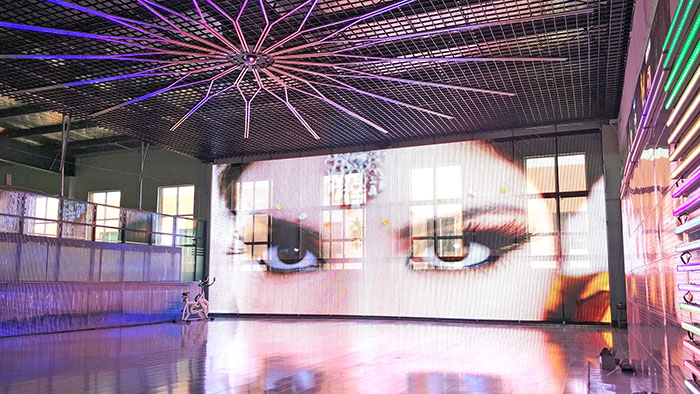
Project and product video: P31.25 media facade in operation.

P31.25 LED Mesh Cabinet
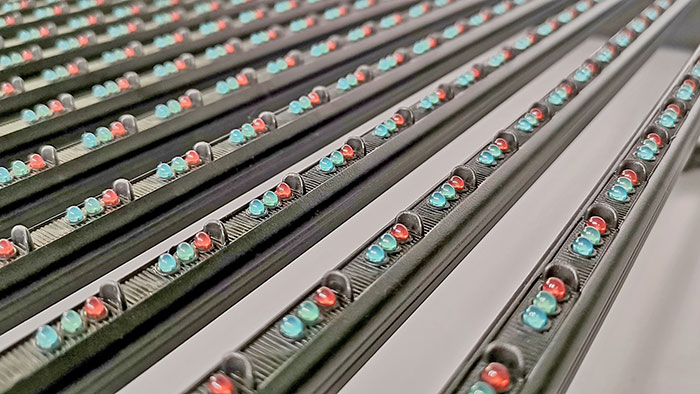
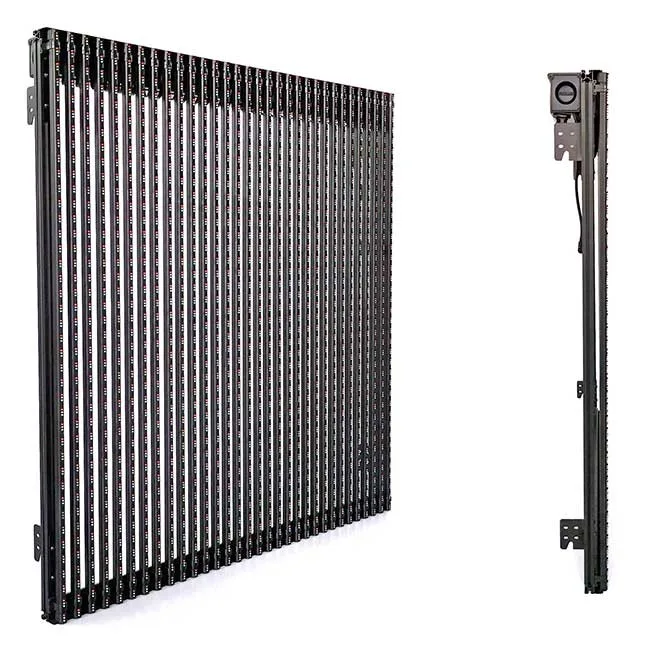
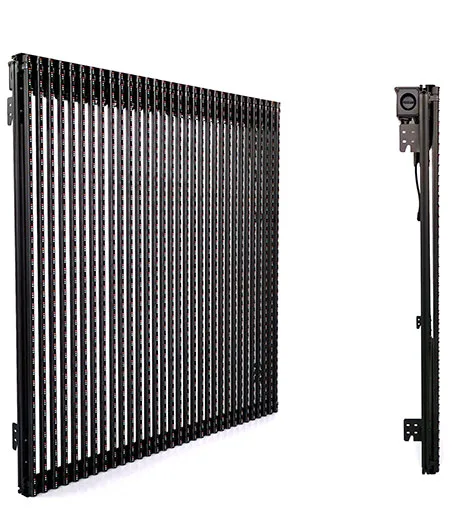
P31.25 media facade mesh panel — aluminium cabinet with DIP346 lamps.
P31.25 LED Mesh Cabinet
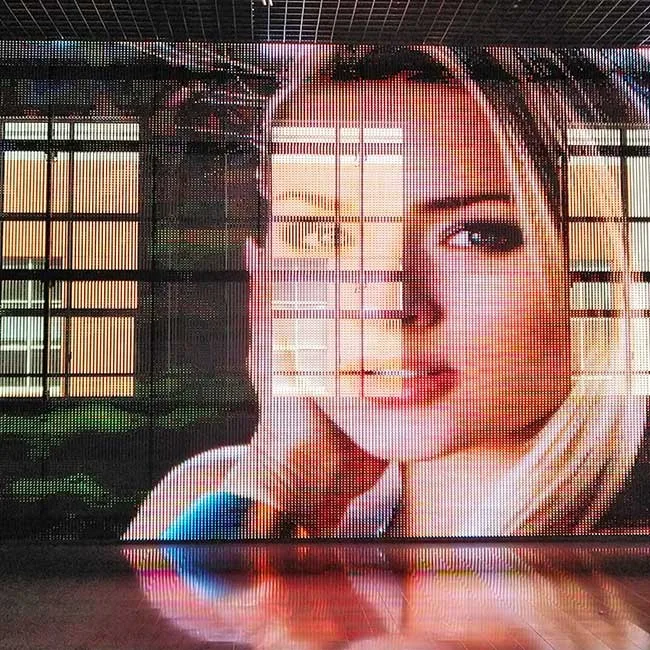
Open mesh structure: light, air and view pass through the 65% transparent surface.

What Is a Building Media Facade?

A building media facade turns an exterior wall into a programmable display surface. Unlike a billboard bolted to a wall, a media facade is designed with the architecture: it shares the building's structure, respects its glazing and proportions, and becomes part of how the building looks at night.

Commercially, it changes what a wall can earn. A facade that used to be a fixed cost becomes advertising inventory, event space and a landmark marker. Technically, it changes what the building must carry — which is why weight, wind load, power and maintenance access decide whether a facade concept is buildable long before pixel pitch is discussed.

Why a Mesh Cabinet for a Permanent Facade

Three formats compete for facade work: solid outdoor cabinets, transparent film, and mesh cabinets. The mesh cabinet sits in the middle — enough pixel density to carry real content, open enough to keep the building reading as a building.

  • 65% transparency keeps windows and structure visible; the mesh reads as a grid rather than a solid wall.
  • 11.8 kg/m² is a fraction of a conventional solid steel cabinet, so the sub-frame and anchors are smaller.
  • IP67 and −40 to +80 °C cover permanent outdoor duty rather than event use.
  • Front or rear service means a failed module can be reached from whichever side the building allows.
  • Vertical fixing and 1 m² modules make a facade grid straightforward to lay out and re-order.

Technical Specification

H3125 / P31.25 media facade cabinet
Model H3125 — P31.25 × 25 mm media facade mesh cabinet
LED type DIP346 (1R1G1B)
Pixel pitch 31.25 mm horizontal × 25 mm vertical
Pixel density 32 × 40 per m² (1,280 dots/m²)
Cabinet size 1,000 × 1,000 × 120 mm, aluminium alloy
Brightness up to 7,500 nits
Grayscale 16-bit (65,536 levels)
Refresh rate 3,840 Hz
Driver IC ICN2038S
Viewing angle H 140° / V 110°
Transparency 65%
Weight 11.8 kg per m² cabinet
Power 450 W/m² max · 95 W/m² average
Supply 100–240 V AC input · 5 V DC drive
Ingress protection IP67
Operating temperature −40 °C to +80 °C · humidity 10–90%
Viewing distance 20–500 m suggested
Control Novastar receiving card; 32/40/64-output sub-controller; one cable per cabinet for signal and power
Maintenance Front or rear
Warranty 3 years

The Numbers That Decide If a Facade Works

Before content, do the four sums. They are what separates a render from a buildable project.

Worked example at 11.8 kg/m², 450 W/m² max, 95 W/m² average
Facade area Cabinet weight Peak power Average power Total pixels
100 m² 1.18 t 45 kW 9.5 kW 128,000
300 m² 3.54 t 135 kW 28.5 kW 384,000
500 m² 5.9 t 225 kW 47.5 kW 640,000
What these numbers mean in practice: a 500 m² facade adds 5.9 tonnes of screen to the building before steel, and needs roughly 48 kW at average brightness — which usually means a dedicated supply, not a tap off the existing board. Bring both figures to the structural and electrical engineers in the first meeting, not after the design is fixed.

Choosing Pixel Pitch for a Facade

Pitch should follow the distance from which people actually look at the building, not the resolution you would like on paper. As a starting point:

Pitch guidance against typical street and plaza viewing distances
Viewing distance Typical format What it supports
20–40 m (street level, opposite pavement) P15.625 – P25 Logos, short words, recognizable video
40–100 m (plaza, adjacent block) P25 – P31.25 Brand graphics and motion, still readable
100–300 m (across a junction or river) P31.25 – P50 Large graphics and color fields
300 m+ (city scale, skyline) P50 and above Big shapes and light effects

Below P25 the pixel count climbs fast and so does cost per square metre; above P50 the facade becomes a light canvas rather than a video surface. P31.25 × 25 mm is the usual compromise for a commercial elevation seen from 40–100 m.

Installation: Three Site Conditions

1. On a solid wall

A steel sub-frame is anchored to the wall and the cabinets fix to it vertically. Because the cabinet is 11.8 kg/m², the sub-frame is lighter than a solid-cabinet solution, but the wind load on the whole elevation still governs the anchor design.

2. In front of a glass curtain wall

The mesh sits off the glass on standoffs or a light frame, preserving daylight and the view out. This is where transparency earns its money: from inside, the facade reads as a grid; from outside, it is a display. Confirm the standoff depth with the facade contractor so cleaning and glass access remain possible.

3. On a feature structure

Canopies, towers and entrance portals usually need a bespoke frame. Fixing is vertical by design, so horizontal or inclined surfaces require a project-specific bracket design — ask for a drawing rather than assuming the standard detail works.

Who owns the steel? Decide this early. Most facade disputes are not about pixels; they are about who designed the sub-frame, who calculated the wind load, and who signs off the anchors.

Maintenance on a High-Rise Facade

Front or rear access per cabinet is the specification that decides lifetime cost. On a tower, a rear-service design means maintenance happens from inside the building — no rope access, no scaffold, no street closure. Where the building gives no rear void, front service from a gondola or BMU is the fallback.

  • Keep a spare-module stock matched to the production batch: color and brightness consistency between runs must be managed.
  • Agree an inspection interval after the first storm season, then annually.
  • Record the cabinet serial map, so a failed module can be located from the control room rather than by walking the facade.

Control and Content

The cabinet carries a Novastar receiving card, with a 32/40/64-output sub-controller and a single cable per cabinet for signal and power — which reduces the wiring that has to be got right at height. Content is mapped to the facade grid: at 32 × 40 pixels per square metre, a 300 m² elevation is 384,000 pixels, so the media plan should be built on the actual pixel map rather than on a scaled-down video.

For multi-zone elevations, decide whether zones show one continuous composition or independent content; see our multi-screen synchronization guide for how the two modes differ.

Media facade LED mesh cabinet installed on a building exterior
Facade installation: cabinets fixed vertically to a project sub-frame.
Building media facade LED mesh showing content at night
Night operation: the same surface becomes a media display.

Control Hardware and Wiring

Novastar control wiring diagram for media facade LED mesh cabinets
Signal and power topology across the facade grid.
Novastar controller configuration for a building media facade
Controller configuration before commissioning.
800W and 1200W power supply with Novastar receiving card and 32/64 output sub-controller
800 W / 1,200 W PSU with pre-built Novastar receiving card and 32/40/64-output sub-controller.

Applications

  • Commercial and retail elevations — advertising and brand presence on the building itself
  • Hotels and mixed-use towers — a landmark identity that doubles as media inventory
  • Shopping centres and transport hubs — large-format wayfinding and campaign space
  • Landmark and civic buildings — programmed light and event content
  • Bridges and feature structures — where an open mesh suits the structure

Media Facade or Transparent Media Mesh?

Both are in our range, and the choice is usually structural rather than visual.

  • This P31.25 cabinet — permanent facade, standard module grid, front/rear service, best where the wall can carry a frame and the viewing distance is 40 m or more.
  • Transparent media mesh — flexible, lighter, better for glass curtain walls, curves and irregular surfaces where a rigid grid cannot follow. See the P15.625 media mesh.
  • Flexible mesh fabric — for wrapping, shaping and decor where transparency and bendability matter more than cabinet rigidity. See the bendable LED mesh range.

Frequently Asked Questions

What is a building media facade?

An exterior building surface designed to display programmable media. It can be built from solid cabinets, transparent mesh or flexible mesh, depending on how much daylight and view the building needs to keep.

How heavy is this media facade?

11.8 kg per m² of cabinet. Add the sub-frame, cabling and fixings for the structural calculation — the screen weight alone is not the load the building carries.

How transparent is it?

65%. The open mesh keeps windows and structure visible through the surface rather than blocking them.

Which pixel pitch should I choose?

Match it to viewing distance: P15.625–P25 for 20–40 m, P25–P31.25 for 40–100 m, P31.25–P50 for 100–300 m, larger pitches beyond that. P31.25 × 25 mm suits commercial elevations seen from 40–100 m.

Can modules be replaced without scaffolding?

Yes, if the building allows rear access — the cabinet supports front or rear maintenance. On elevations with no rear void, plan front service from a gondola or BMU.

How much power does a facade need?

450 W/m² maximum and 95 W/m² average. A 300 m² facade is 135 kW peak, 28.5 kW average — usually a dedicated supply.

Is IP67 enough for coastal buildings?

IP67 protects the enclosure against dust and water ingress. Coastal sites also need corrosion-resistant fixings, sealed cable entries and a maintenance routine; confirm the mounting hardware specification with us for the site.

What control system does it use?

Novastar receiving cards with a 32/40/64-output sub-controller and one cable per cabinet for signal and power. The player depends on total pixel count and whether content is scheduled or live.

Specify a Media Facade

Send the elevation drawings or photos, facade area, viewing distance, structure type and available power. We will confirm pitch, cabinet count, sub-frame loads and the control plan.

Request a Facade Specification

Specifications are reference values; confirm the current datasheet and the selected configuration before ordering. Brightness figures are configuration-dependent. Related: P15.625 transparent media mesh · P41.6 LED mesh curtain · flexible LED mesh fabric · multi-screen synchronization.

Related Products

P31.16 Pixel Mesh

P31.16 Pixel Mesh

String Curtain Lights

String Curtain Lights

MR502 LED Controller

MR502 LED Controller

Novastar TB40 Multimedia Player

Novastar TB40 Multimedia Player

Product Categories

  • Drone Flying LED Screen
  • LED Mesh Screen
  • Transparent LED Screen
  • Digital Water Curtain

Links

Google.comFushilongNovastarBaidu.com

Feedback

Contact Us

8615150798219

15150798219

info@royaladtek.com

peterwu1987

Beidou Electronic Information Industrial Park, Suqian High-tech Industrial Development Zone, Suqian City, Jiangsu Province, China

MOBILE WEBSITE

© 2026 All Rights Reserved.

  • 15150798219
  • info@royaladtek.com
  • 8615150798219 Scan to chat on WhatsApp
  • WeChat QR Code Scan to chat on WeChat
  • Get a Quote
  • Back to Top

Online Inquiry

Get a quote within 12 hours

Tell us what you need — we'll reply as soon as possible.

WhatsApp
Phone
E-mail
Inquiry