Royal AD Tek | Aerial LED Display Technology
What if three drones could carry three independent LED screens and work together as one giant flying video wall?
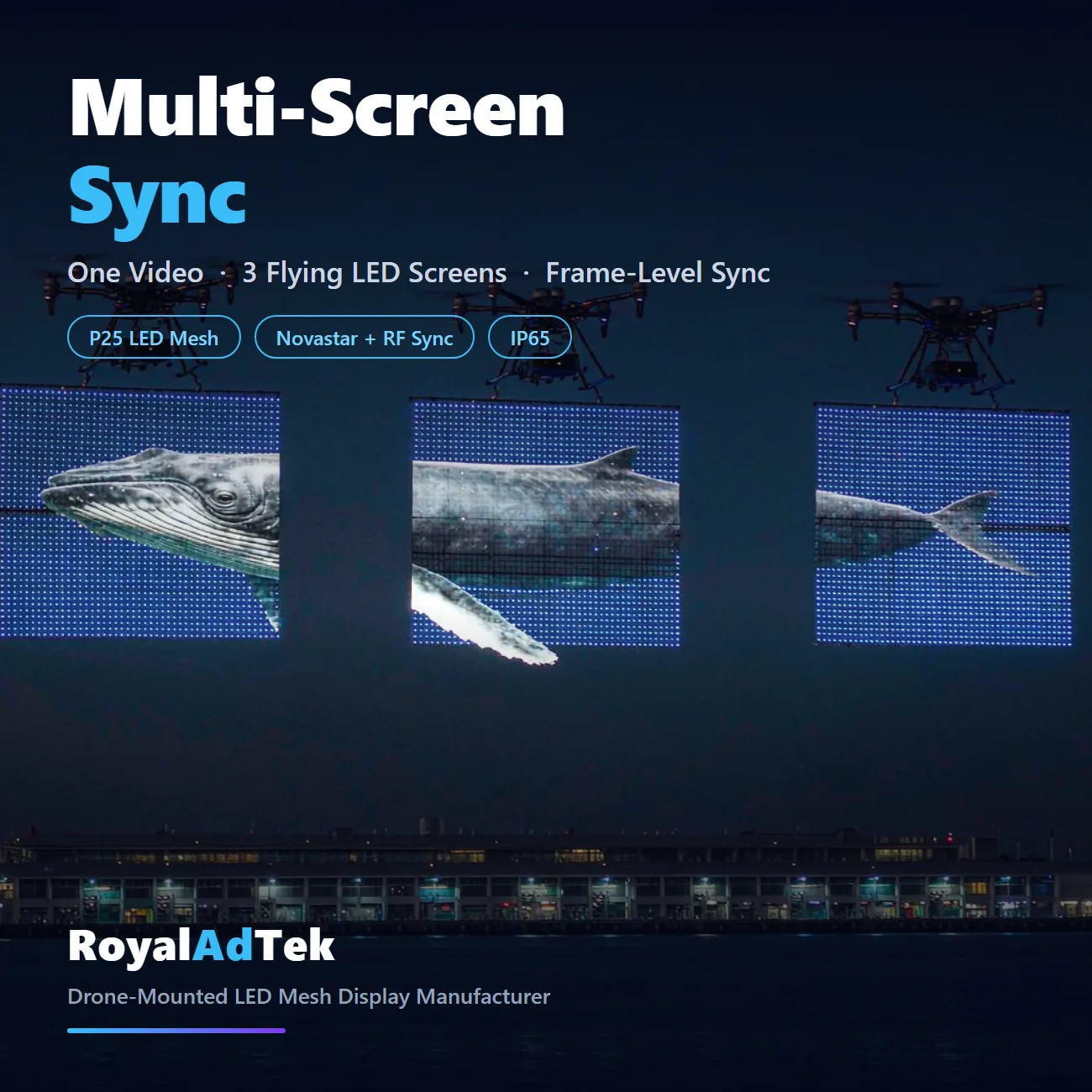
During the 2026 New Year countdown in Lianyungang, China, Royal AD Tek demonstrated a multi-screen aerial LED display featuring three P25 drone flying LED mesh screens . Each flexible screen was suspended beneath its own heavy-lift drone, creating a coordinated visual performance in the night sky.
Instead of operating as three independent advertising displays, the screens were configured for synchronized playback and split-screen video effects. A whale animation demonstrated how separate aerial LED displays could work together to present one large-scale visual composition.
What is a multi-screen drone LED display?
A multi-screen drone LED display consists of two or more independently suspended LED mesh screens using coordinated content playback. Each screen can display the same video or a different segment of a larger visual composition, enabling synchronized aerial advertising, event visuals and flying video wall performances.
Two Playback Modes for Multi-Drone LED Screen Shows
A multi-drone LED screen system can be designed around two principal playback modes: synchronized playback and split-screen playback. Each mode serves a different creative and commercial purpose.
Mode 1: Synchronized Playback — Same Video on Every Screen
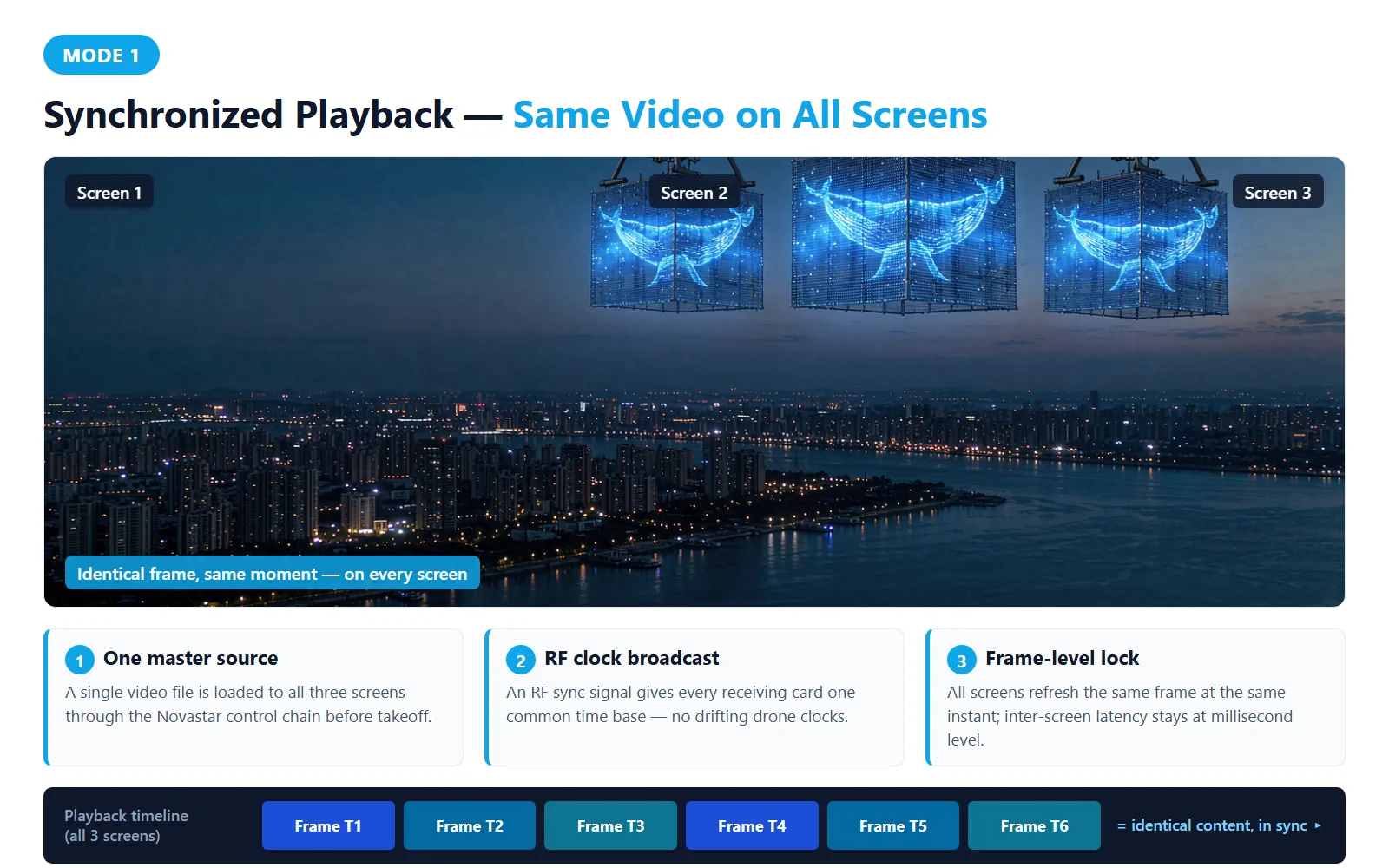
In synchronized playback mode, every flying LED screen displays the same video, animation, logo or countdown sequence. Coordinated timing helps the screens present matching visual content throughout the performance.
This configuration is particularly useful when audiences are distributed across a large event venue or when a brand message needs to be repeated across multiple aerial display positions.
- Content: The same video or animation on every screen.
- Visual effect: Coordinated aerial displays presenting a consistent message.
- Content preparation: Matching media files and playback settings.
- Applications: Countdown celebrations, corporate branding, festival visuals and coordinated event messages.
Mode 2: Split-Screen Playback — One Video Across Multiple Drones
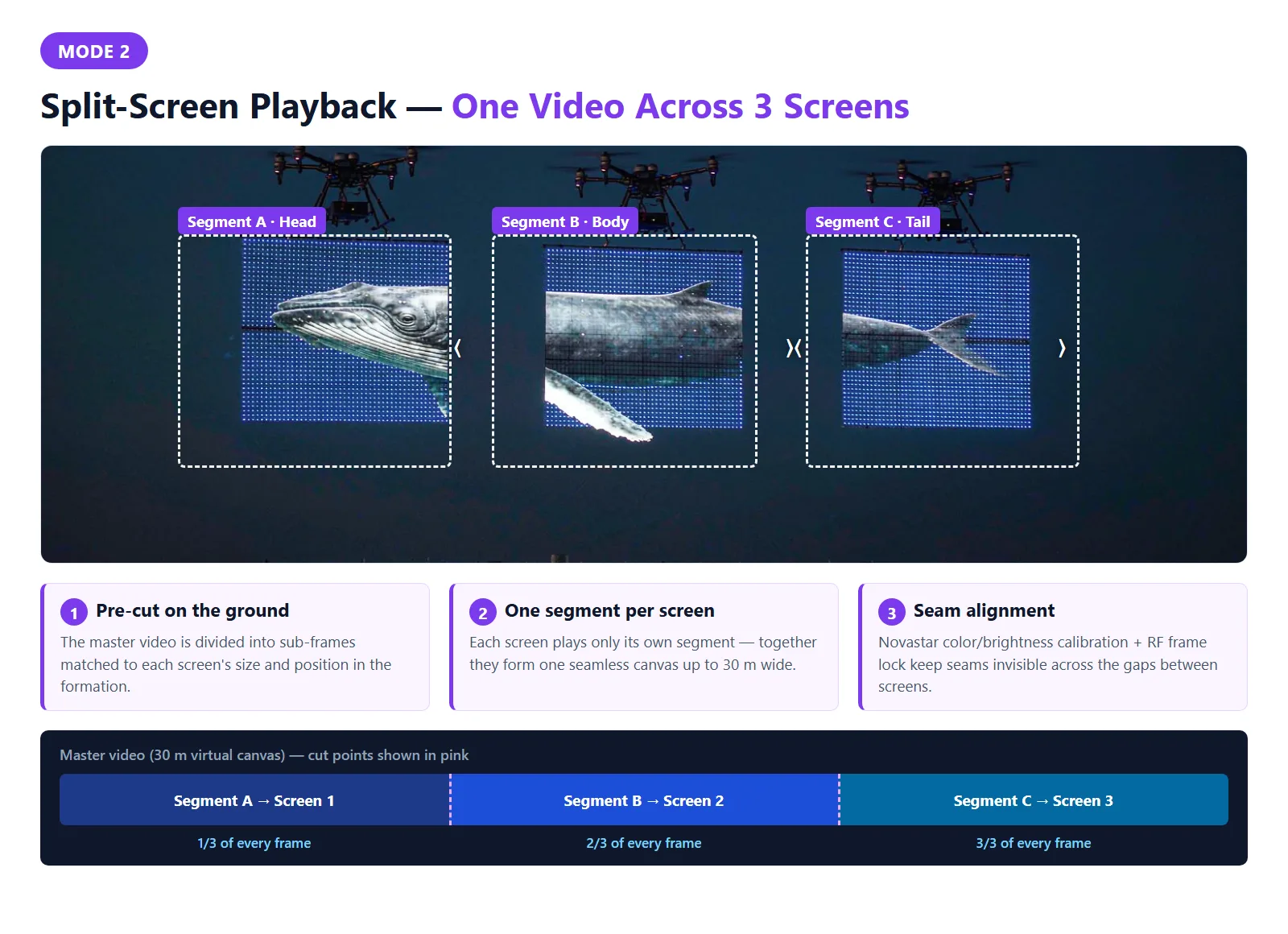
Split-screen playback distributes a single master video across multiple drone-mounted LED screens. Each display presents a specific portion of the original content according to its assigned position in the aerial formation.
In the whale demonstration, the first screen presented the head, the second displayed the body, and the third completed the animation with the tail. Together, the three P25 LED mesh displays produced a visual effect that would not fit within a single screen of the same dimensions.
- Content: One master video divided into individual screen-specific media files.
- Visual effect: A large-format flying video wall with coordinated imagery.
- Content preparation: Resolution mapping, content segmentation and synchronized playback settings.
- Applications: Cinematic animations, product launches, storytelling and aerial digital advertising.
Unlike a conventional ground-based LED video wall, a multi-drone display has physical gaps between screens and changing viewing geometry. Content must be designed with these characteristics in mind rather than assuming a physically seamless display surface.
Synchronized Playback vs. Split-Screen Playback
| Comparison | Synchronized Playback | Split-Screen Playback |
|---|---|---|
| Video content | Same content on all screens | Different segments of one video |
| Visual purpose | Repeated brand or event messaging | One large aerial composition |
| Content preparation | Matching media files | Screen-specific video mapping |
| Formation dependency | Lower visual dependency | Higher visual alignment requirements |
| Timing requirements | Coordinated playback | Coordinated playback across segments |
| Typical content | Logos, slogans and countdowns | Wide animations and storytelling |
| Best applications | Brand visibility and event messaging | Large-scale aerial visual experiences |
How Multi-Screen Flying LED Synchronization Works
The multi-screen display concept combines independent LED media players, coordinated video content and wireless synchronization. Royal AD Tek's P25 flying LED mesh system supports NovaStar-based media control, with multi-screen synchronization configurations selected according to the project.
01. Master Video Preparation
The original video is designed according to the number of screens, their pixel resolution and intended arrangement.
For split-screen playback, the master content is divided into individual video segments. Each segment corresponds to one screen in the overall aerial composition.
02. NovaStar Media Control
Each P25 flying LED screen operates using its own compatible media playback and LED control system.
The NovaStar TB10 Plus is a listed controller option for the P25 product, supporting asynchronous content playback and Wi-Fi management.
Multi-screen timing functionality must be configured using compatible controllers, firmware and synchronization equipment.
03. RF Wireless Synchronization
Radio-frequency synchronization can provide a shared timing reference for independent display units, helping coordinate media playback without a physical signal cable connecting the airborne screens.
The synchronization design, supported screen count, operating distance and timing accuracy depend on the selected control configuration and verified system performance.
04. Consistent Brightness and Color
Matching brightness, grayscale configuration and color settings across screens helps improve the visual consistency of the complete display.
Brightness must remain within the approved operating settings for each screen and battery configuration.
05. Ground Testing and Playback Verification
Before an aerial performance, the complete multi-screen playback sequence should be tested on the ground.
Content alignment, screen identification, playback timing and electrical performance must be verified before the system is handed over to the qualified flight team.
LED Refresh Rate Is Not the Same as Video Synchronization
LED refresh rate describes how frequently the LED display updates its light output. Video frame rate describes the number of video frames presented per second, while multi-screen synchronization describes how closely independent screens align their playback timing.
A high-refresh-rate LED mesh can improve the appearance of camera-recorded content, but it does not automatically guarantee frame-level synchronization between multiple media players.
Reliable multi-screen aerial video playback requires compatible media control, consistent content settings and verified synchronization performance.
How Large Can a Flying LED Video Wall Be?
Multiple drone-carried LED displays can create a much wider visual composition than a single aerial screen. The effective content dimensions depend on screen size, orientation, pixel pitch and the intended arrangement.
Example: Three Landscape-Oriented 5 × 10 m P25 Screens
Consider three P25 screens, each configured with a 10-meter horizontal width and a 5-meter vertical height.
| Parameter | Single Screen | Three Screens |
|---|---|---|
| Active display width | 10 m | 30 m combined |
| Display height | 5 m | 5 m |
| LED display area | 50 m² | 150 m² |
| Pixel pitch | 25 mm | 25 mm |
| Content resolution | 400 × 200 | 1200 × 200 |
| Total RGB pixels | 80,000 | 240,000 |
In this example, the master video uses a logical composition of 1200 × 200 pixels and is divided into three 400 × 200 pixel segments.
The resulting display has a combined active screen area of 150 square meters, providing an ultra-wide canvas for abstract animations, large-scale branding and visual storytelling.
This is an illustrative content-mapping example, not a specification of the Lianyungang demonstration. Physical gaps between screens are excluded. Actual screen orientation, suspension configuration, formation geometry and flight operations require project-specific engineering and approval.
Why Flexible P25 LED Mesh Is Suitable for Aerial Displays
Conventional rigid LED display cabinets are generally unsuitable for drone-carried advertising because of their substantial structural weight and power-system requirements.
The Royal AD Tek P25 flying LED screen mesh is designed specifically for lightweight aerial display applications.
- Lightweight screen body: Approximately 0.75 kg/m², excluding batteries, control equipment and suspension components.
- 25mm pixel pitch: 1,600 RGB pixels per square meter for large-format aerial video content.
- Open-mesh construction: Approximately 70% transparency allows air and background light to pass through the mesh.
- Flexible grayscale options: 8-bit or 16-bit configurations for different video-quality requirements.
- Battery-powered operation: Configurable power systems allow independent display operation without a ground power cable.
- IP65-rated construction: Designed for suitable outdoor environments, subject to approved operating conditions.
- Custom display dimensions: Screen size and system configuration can be selected according to project requirements.
Watch the P25 Flying LED Screen in Action
Explore the Royal AD Tek flying LED mesh technology and see how flexible RGB video displays can be used for aerial visual experiences.
Official Royal AD Tek flying LED screen demonstration. For additional product tests, installation videos and project performances, visit our official Instagram channel .
P25 Flying LED Mesh Screen Technical Overview
| Specification | P25LMP Series |
|---|---|
| Display type | Flexible drone-mounted LED mesh |
| Pixel pitch | 25 mm |
| Pixel density | 1,600 pixels/m² |
| Grayscale options | 8-bit / 16-bit |
| Maximum brightness | Up to 2,800 cd/m² |
| Transparency | 70% |
| Screen body weight | Approximately 0.75 kg/m² |
| Ingress protection | IP65 |
| Power system | 12V lithium battery configuration |
| Media controller | NovaStar TB10 Plus |
| Multi-screen modes | Synchronized / Split-screen playback |
| Wireless synchronization | Project-specific compatible configuration |
| Screen dimensions | Standard and customized sizes |
Flight brightness is lower than the maximum module brightness and must follow the approved system configuration. Multi-screen synchronization features and performance should be confirmed before ordering.
Featured Product
P25 Drone Flying LED Screen Mesh — P25LMP
A lightweight, battery-powered flexible LED display system developed for drone-carried aerial advertising, flying video walls and creative outdoor event performances.
- 25 mm pixel pitch and 70% transparency
- 8-bit and 16-bit grayscale options
- Multiple screen and battery configurations
- NovaStar media control
- Project-specific multi-screen playback support
Applications of Multi-Screen Drone LED Displays
Aerial Advertising and Brand Campaigns
Multiple flying advertising screens can display coordinated brand identities, promotional animations and product visuals across a large event space. Split-screen playback offers an additional creative format for wide product reveals and memorable visual storytelling.
New Year Countdowns and City Celebrations
Synchronized flying LED displays can present countdown animations, celebration graphics and coordinated event messages. The Lianyungang demonstration illustrates the creative potential of combining multiple aerial video screens.
Related project: China Flying LED Screen Show to Welcome 2026 .
Concerts, Festivals and Entertainment Shows
Drone-carried LED mesh screens introduce a moving video-display element into outdoor entertainment productions. Coordinated animations can complement stage lighting, music, projection mapping and other programmed visual effects.
Sports Ceremonies and Corporate Events
Multi-screen aerial displays offer an additional format for presenting sponsor branding, opening ceremony visuals and coordinated promotional content at suitable approved venues.
Tourism, Cultural Events and Visual Storytelling
Large animated characters, landscape-inspired visuals and narrative sequences can be distributed across several screens to create distinctive aerial media experiences.
All aerial display operations are subject to local aviation regulations, approved operating areas, payload assessment, weather restrictions and qualified flight-team supervision.
Flying LED Screens vs. Traditional Drone Light Shows
A traditional drone light show typically uses numerous illuminated drones as individual points of light to form shapes and patterns in the sky.
A drone-mounted LED screen instead carries a flexible matrix of RGB pixels capable of displaying video content, graphics and animated branding.
| Feature | Traditional Drone Light Show | Drone LED Screen Show |
|---|---|---|
| Visual medium | Individual illuminated drones | Flexible RGB LED video screens |
| Content format | Formation-based patterns | Pixel-mapped video and graphics |
| Display geometry | Distributed light points | Defined mesh display surfaces |
| Branding approach | Formation-based logos and shapes | Video-based advertising content |
| Drone requirements | Dedicated show-drone fleet | Compatible heavy-lift drones |
These technologies address different creative requirements and can complement one another within appropriately planned event productions.
Frequently Asked Questions
Can three drone LED screens play one continuous video?
Yes. A compatible multi-screen control configuration can coordinate three individual video segments derived from one master video, producing a combined aerial visual composition.
What is the difference between synchronized and split-screen playback?
Synchronized playback presents identical content on multiple screens. Split-screen playback assigns a different section of one master video to each screen.
How many flying LED screens can be synchronized?
Royal AD Tek has demonstrated a three-screen configuration. Larger systems require confirmation of controller compatibility, synchronization capability, communication performance and operational requirements.
Does every flying LED screen require its own controller?
Each independently powered drone-mounted display requires compatible LED control and media playback hardware. Additional equipment may be required for coordinated multi-screen synchronization.
Can both playback modes be used in the same show?
Both modes can be incorporated into a compatible show design. The ability to switch between them during a performance depends on the selected controller configuration and verified playback functionality.
Does split-screen playback require special video production?
Yes. The master video must be mapped to the resolution and position of each individual screen. Content should also account for physical gaps and the intended audience viewing geometry.
Can the P25 flying LED screen display live video?
The standard asynchronous media playback configuration is intended for uploaded content. Live video transmission requires a separately confirmed compatible control and communication system.
Is LED screen runtime the same as drone flight time?
No. LED screen runtime refers to the display's independent battery-powered operating duration. Drone flight time depends on the aircraft, total payload, battery system, weather and approved operating conditions.
Does Royal AD Tek supply heavy-lift drones?
Royal AD Tek manufactures and supplies flying LED mesh screens, compatible display controllers, battery configurations and selected suspension accessories.
We recommend sourcing a compatible heavy-lift drone locally for manufacturer support, maintenance, insurance and regulatory compliance.
How can I request a multi-screen drone LED display quotation?
Provide the number of screens, individual screen dimensions, desired playback mode, drone model, approved payload, target display runtime and project location. Our team can review the display configuration and prepare a project-specific quotation.
Manufacturer Direct | Custom Aerial LED Solutions
Plan Your Multi-Screen Flying LED Display Project
Looking to create a synchronized aerial advertising display, wide-format flying video wall or multi-drone LED screen performance?
Royal AD Tek provides customizable P25 flying LED mesh systems for drone light show companies, event production teams, aerial advertising agencies and professional AV integrators.
Share your project requirements:
- Number of flying LED screens
- Required screen dimensions and orientation
- Drone model and approved payload capacity
- Synchronized or split-screen playback
- Target display runtime and event location
- Existing media control requirements
Email: info@royaladtek.com
Manufacturer: Royal AD Tek, China